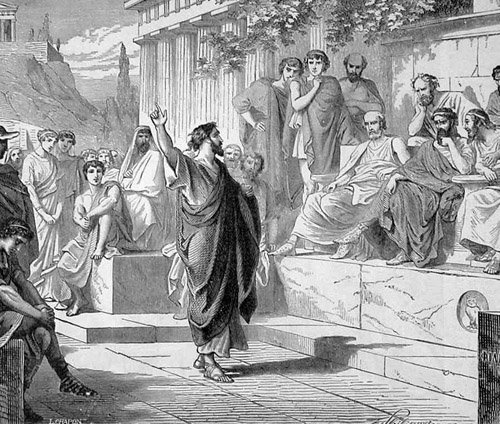
Woodcut for “Die Bibel in Bildern”, 1860. Artist: Julius Schnorr von Carolsfeld (1794-1872)
“Jesus died because He loves us.”
The meaning of this statement was taken to a whole new level for me once I understood why Jesus may have wanted His disciples to be armed on the night before He was crucified.
Luke 22:35-38 35 Then Jesus asked them, “When I sent you without purse, bag or sandals, did you lack anything?”
“Nothing,” they answered.
36 He said to them, “But now if you have a purse, take it, and also a bag; and if you don’t have a sword, sell your cloak and buy one.37 It is written: ‘And he was numbered with the transgressors’; and I tell you that this must be fulfilled in me. Yes, what is written about me is reaching its fulfillment.”
38 The disciples said, “See, Lord, here are two swords.”
“That’s enough!” he replied.
I found this passage perplexing since Jesus commanded His disciples to buy swords but then when they said they already had two, Jesus said that would be enough. What was He referring to? Enough for what??
Well I read an article about Dale Martin, who is a professor of religious studies at Yale University (link at the bottom), that may explain it. The article is titled:
Jesus Was Crucified Because Disciples Were Armed, Bible Analysis Suggests
The writer of the article actually tries to prove a different point about how Jesus was trying to be a political leader.
What the writer didn’t mention are verses that would prove this view wrong, that His disciples thought that’s what the Messiah would do all along; free them from Roman rule, but the Bible is clear on all accounts that this was not why Jesus came to earth. Regardless, if Jesus’s disciples having swords did make the crucifixion possible, it is pretty amazing to think about how the events leading up to Jesus’s death actually unfolded.
In Luke, it’s recorded that before Jesus was betrayed, He told His disciples to buy swords. They told Him they had two already and He said that was enough. This seems strange, what good would two swords do all of them? Well according to the article mentioned above, by Roman law, Jesus was crucified because of the swords His disciples were carrying the night He was captured. If that was the case, He actually made sure they had swords so that He would be crucified.
Also, Jesus wanted them to have the two swords to fulfill a prophecy in Isaiah.
Therefore I will give him a portion among the great, and he will divide the spoils with the strong, because he poured out his life unto death, and was numbered with the transgressors. For he bore the sin of many, and made intercession for the transgressors.(Isaiah 53:12)
So what seems like a strange request by Jesus the night before being betrayed, humiliated, beaten, and crucified was possibly a request to ensure that He would be crucified to fulfill the prophecies about Him and save the lost. What an amazing God we serve!
If you read this article and do not know Jesus as your personal Lord and Savior, please send us an email (Theologetics3.15@gmail.com). We would love to tell you more about how to have a personal relationship with Him!
There are natural laws built into the fabric of our existence. Laws like gravity.
These laws, that can be tested by science, are necessary for our existence and are very finely tuned. So much so, that they are difficult to imagine originating on their own by chance.
One such law is so finely tuned, it has been shown that to have happened naturally on its own, by what we know about our universe without something to finely-tune it (God), would be absurd. To have happened on its own would practically be impossible; this law is the cosmological constant.
Scientific theorists have pointed to other possibilities to get around the need for a fine-tuner, one popular idea is that our universe is just one of an infinite number of universes, each with it’s own naturally developed laws. This means that within this “multiverse”, it isn’t absurd to think that our universe is as finely tuned as we measure it to be because if there are an infinite number of universes out there, then at least some would end up with ideally tuned laws for the existence of life.
Scientifically there is a problem with theories like these; they are not scientific. At least not in the sense that they can be measured, observed, and quantified.
Despite this problem, there are many scientists who entertain this idea of a multiverse or even outright believe it exists. The interesting thing is that many of these same scientists would likely be quick to dismiss the idea that God was the one who fine-tuned our universe making it ideal for life on earth.
The point of this article is that the Bible says that nature itself is evidence that God exists.
Romans 1:20 For ever since the world was created, people have seen the earth and sky. Through everything God made, they can clearly see his invisible qualities—his eternal power and divine nature. So they have no excuse for not knowing God.
The scientist who says that a multiverse explains our natural existence occurring by chance or the believer who says that God explains our finely-tuned existence by His eternal power are both making the same statement, and that statement is this:
“I have FAITH!”
If you would personally like to know the God who made our universe, the God who is love, the God who knows who you are and wants you to know Him. If you would like to know Him, just message us (Theologetics3.15@gmail.com), we would love to share!
Author: Doré, Gustave, 1832-1883 Image Title: Angel at the Door of the Sepulchre, woodcut
The Law of Non-Contradiction states that
(A) cannot be both (A) and (non-A) simultaneously.
It is logical to have different aspects of (A), but not contradictory aspects.
Example: John is a father. John is in New York. These are different aspects of the same person. However, logic demands that John cannot be in New York and not be in New York at the same time. This would be contradictory. This goes against logic.
According to the Bible, Jesus died a public death on the cross and rose three days later. All four Gospels testify to the crucifixion referenced below but for the sake of time we will look at John specifically:
Matthew 27:45-60
Mark 15:33-39 Luke 23:44-49
John 19:16-33 16. Finally Pilate handed him over to them to be crucified. So the soldiers took charge of Jesus. 17. Carrying his own cross, he went out to the place of the Skull (which in Aramaic is called Golgotha). 18. There they crucified him, and with him two others—one on each side and Jesus in the middle. 19. Pilate had a notice prepared and fastened to the cross. It read: Jesus of Nazareth, the king of the Jews. 20. Many of the Jews read this sign, for the place where Jesus was crucified was near the city, and the sign was written in Aramaic, Latin and Greek. 21. The chief priests of the Jews protested to Pilate, “Do not write ‘The King of the Jews,’ but that this man claimed to be king of the Jews.” 22. Pilate answered, “What I have written, I have written.” 23. When the soldiers crucified Jesus, they took his clothes, dividing them into four shares, one for each of them, with the undergarment remaining. This garment was seamless, woven in one piece from top to bottom. 24. “Let’s not tear it,” they said to one another. “Let’s decide by lot who will get it.” This happened that the scripture might be fulfilled that said, “They divided my clothes among them and cast lots for my garment.” So this is what the soldiers did. 25. Near the cross of Jesus stood his mother, his mother’s sister, Mary the wife of Clopas, and Mary Magdalene. 26. When Jesus saw his mother there, and the disciple whom he loved standing nearby, he said to her, “Woman, here is your son,” 27. and to the disciple, “Here is your mother.” From that time on, this disciple took her into his home. 28. Later, knowing that everything had now been finished, and so that Scripture would be fulfilled, Jesus said, “I am thirsty.” 29. A jar of wine vinegar was there, so they soaked a sponge in it, put the sponge on a stalk of the hyssop plant, and lifted it to Jesus’ lips. 30. When he had received the drink, Jesus said, “It is finished.” With that, he bowed his head and gave up his spirit. 31. Now it was the day of Preparation, and the next day was to be a special Sabbath. Because the Jewish leaders did not want the bodies left on the crosses during the Sabbath, they asked Pilate to have the legs broken and the bodies taken down. 32. The soldiers therefore came and broke the legs of the first man who had been crucified with Jesus, and then those of the other. 33. But when they came to Jesus and found that he was already dead, they did not break his legs.
As you can see, according to the Gospels, Jesus died. In addition to this the Bible is clear on the importance of Christ’s death, resurrection, and ascent into heaven:
1 Corinthians 15 & 1 Timothy 3:16-17
In Islam, the Quran mentions Jesus more than any other Prophet. It states He was born of a virgin (Surah 19), had disciples (5:111-115), ascended into heaven (4:158), and will return as a sign of the end times (43:61). However, unlike the Bible, the Quran states that Jesus did not die:
Quran 4:157-158 That they said (in boast), “We killed Christ Jesus the son of Mary, the Messenger of Allah”;- but they killed him not, nor crucified him, but so it was made to appear to them, and those who differ therein are full of doubts, with no (certain) knowledge, but only conjecture to follow, for of a surety they killed him not:- Nay, Allah raised him up unto Himself; and Allah is Exalted in Power, Wise;
Now, we go back to the logic stated at the beginning. (A) cannot be both (A) and (non-A). Both can’t be true. Here, we have the Bible (particularly the Gospels) stating Jesus died and the Quran stating that He didn’t. Both cannot be true.
But wait, the Quran makes a couple other very important claims. –God sent the Gospels
3:3 It is He Who sent down to thee (step by step), in truth, the Book, confirming what went before it; and He sent down the Law (of Moses) and the Gospel (of Jesus) before this, as a guide to mankind, and He sent down the criterion (of judgment between right and wrong) 5:46 And in their footsteps We sent Jesus the son of Mary, confirming the Law that had come before him: We sent him the Gospel: therein was guidance and light, and confirmation of the Law that had come before him: a guidance and an admonition to those who fear Allah,
— The word God sends cannot be changed (corrupted)
6:34 Rejected were the messengers before thee: with patience and constancy they bore their rejection and their wrongs, until Our aid did reach them: there is none that can alter the words (and decrees) of Allah. Already hast thou received some account of those messengers,
Yet, Muslims believe that the Gospels have been altered to show that Jesus died.
What can we say then? The last of the four Gospels, John, can be dated around 80 A.D. The Quran is dated 570 years later at around 650 A.D.
Jesus either did die or didn’t die. Both books can’t be right on this subject. However, looking at the Gospels and what the Quran teaches about the Gospels, the only logical conclusion on the matter is Jesus was crucified. Both texts affirm it when logic is applied!
So let us recount the sequence of events:
Logic: (A) cannot be both (A) and (non-A) simultaneously
The Gospels attest to Jesus dying on the cross
While Quran 4:157-158 says that Jesus did not die
But Quran 3:3 & 5:46 says God sent the Gospels
And Quran 6:34 states the word God sends cannot be changed (corrupted)
So we are left with two conclusions:
1. If the Quran is right about Jesus not being crucified, this would mean it is wrong about God’s word being incorruptible, so the Quran itself loses credibility since it states the Gospels and the Quran were both sent by God.
or
2. The Quran, which was written over half a millennium after the Gospels, is simply wrong about Jesus not dying because it changed the account of Christ’s death and resurrection.
If both texts logically affirm the Gospels; and the Gospels state Jesus died a public death, was buried, and raised on the third day, we have one more reason to believe in the authority of the Christian scriptures. We have more reason to place our faith in the atoning work of Jesus, the Son of God!
In his book, AT THE MASTER’S FEET, Sadhu Sundar Singh, Christian missionary, imagines a conversation between a disciple and Jesus in which Jesus says:
The cross is the key to heaven. At the moment when by My baptism I took the cross upon My shoulders for the sake of sinners, heaven was opened, and by means of My thirty-three years bearing of the cross and by death upon it, heaven, which by reason of sin was closed to believers, was for ever opened to them.
Christ Crucified between the Two Thieves: The Three Crosses Rembrandt (Rembrandt van Rijn) (Dutch, 1606–1669) Drypoint, engraving, and scraping; fourth state of five Gift of Felix M. Warburg and his family, 1941 (41.1.33)
The more I learn about God’s Word, the more I stand in awe at how amazing God is. To think, that the book of Genesis, a book written over 1,400 years before Christ was even born, contains specific information about God’s plan to redeem the world by sending his only Son Jesus, it is simply incredible.
This is a subtle foreshadowing of Jesus in Genesis 5, I first heard about this subtlety in a short YouTube video which is linked at the bottom of this article. Now it should be noted that Hebrew cannot be perfectly translated into English, or any language for that matter, so some may disagree on the definitions presented but each one is a definition of the name or the idea behind the name, so I feel the following is pretty amazing!
In Genesis 5 the genealogy from Adam to Noah and a meaning of each name in English is as follows:
1. Adam = Man
2. Seth = Appointed
3. Enosh = Mortal
4. Cainan = Sorrow
5. Mahalalel = The Blessed God
6. Jared = Shall come down
7. Enoch = Teaching
8. Methuselah = His death shall bring
9. Lamech = The despairing
10. Noah = Rest
Some names have multiple meanings and roots but one translation of each of the ten names, one name after the other reads:
Man Appointed Mortal Sorrow, The Blessed God Shall come down Teaching, His death shall bring The despairing, Rest
So there you have it. The story of Jesus in the 5th chapter of Genesis. These names, starting with Adam from the beginning of creation, to Noah around 2,000 years before Jesus was even sent to earth, outline what God had planned all along to get his children back. Not only that, but this is another example of Christ’s divinity.
I believe that God has a reason for every single word in the Bible, every period and every comma, on more dimensions than we can even imagine. Because of that, I believe the ideas behind these names can be translated this way for a reason, and that reason was to show the world in yet another context, that God loves us so much that he gave his One and only Son to save us from our sin!
“Can’t we just read the Bible and worship God without getting all technical?”
Theology is the study of God and is very important. It helps us to understand the God to whom we are worshiping. Proper worship is based on an accurate understanding of who God is. Anytime anyone says anything about God, what is said is something doctrinal. Theology shapes our image of God and if a person’s theology is false then his or her image of God will also be false, which would ultimately lead to idolatry.
In math, the proper answer will proceed from a proper path.
1 + 2 + 3 + 4 = 10
In the same way a proper understanding of who God is, what He would do, and what He wouldn’t do; will inform our doxology (praise) and better guide our prayers.
“Are all these big words and facts really that important?”
For salvation? No. Salvation is not found in head knowledge. However, knowing who God is will help us appreciate Him more, understand the Bible better, and also help us discern false teaching.
Often times we have conversations with family, friends, co-workers, church members, and strangers about God or the Bible. At this point you have just assumed the position of theologian. Apologetics, is the term for defending biblical and theological truths. When these discussions become debates or if you’re just defending you position, you have become an apologist. The more “tools” you have in your mental “toolbox” the better equipped you are to make a defense.
“What about witnessing, isn’t it true that arguing will often just hurt your witness?”
Actually no. If a Christian is just trying to win an argument then he or she will probably do more harm than good but if we allow the Holy Spirit to use the knowledge we have to change a non-believer’s false beliefs about the Bible, Christianity, and God, ultimately this head knowledge can make a huge difference in that person’s heart.
With that said, as Christians, we need to make sure the reasoning we use is sound and that we don’t jump on any “bandwagons” when it comes to modern scientific discoveries. Any scientific argument we use to show that the Bible is accurate could one day be shown to be different or even false, and what the Bible was actually saying may be quite different than what we originally thought but the mistake is not apologetics itself, it would be putting too much trust in man’s knowledge and not enough in the Bible.
An example of this is that through false assumptions and faulty dating methods, many modern scientists believe human life has evolved from smaller and less complex lifeforms over millions of years. While it is quite clear in the Bible that this is not the case and it can even be logically and scientifically shown to be false, there are many Christians who have tried to make the argument that God used evolution to create life. By “jumping on that bandwagon” and taking that stance, it actually weakens the validity of God’s Word because God clearly said in Genesis (written as a historical narrative) that he created everything in the universe in 6 literal days. So when a Christian’s argument becomes making the literal in the Bible something figurative, the Bible becomes a fairy tale instead of something real and that is very sad and dangerous.
I would be remiss if I did not include several disclaimers:
Knowledge of God does not equal a relationship with God. Reading a famous person’s autobiography does not mean you had any kind of relationship with them.
Rebutting objections does not equal evangelism. The goal should be to move someone towards the Gospel.
Head knowledge without the knowledge and guidance of the Holy Spirit can lead to haughtiness and pride. You’re not required to attend each argument you’re invited to. Sometimes the Spirit will move you to be quiet even though you’re knowledgeable on the subject. Sometimes the humble unlearned person will gain spiritual insight and uncanny knowledge when they haven’t been taught by any human. Remember “God apposes the proud but gives grace to the humble.” (James 4:6)
If you read this and want to know more about Jesus, please send us an email at Theologetics3.15@gmail.com we would love to talk with you!
Luther’s thesis nailed to the church door in Wittenberg. Engraved by Johann Leonhard Raab, from a drawing by F. Lessing. New York: T. Whittaker, ca. 1850. [Image no. 4434]Are you a Christian and don’t consider yourself a Catholic? Well, odds are you can thank the Reformation movement that began in 16th century Germany when a young monk named Martin Luther had become outraged with unbiblical teachings that had made its way into Catholic doctrine. On October 31st, 1517 he nailed his “95 theses” on the door of the Church in Wittenburg. These theses protested some of the Pope’s new practices. While he never renounced Catholicism, he began a movement that created more of a division than Luther could have ever imagined. This movement became known as the Protestant Reformation. One result of the Reformation was that the Church went through a purification in that spiritual authority was placed back on scripture alone and not man or tradition.
In celebration of Reformation Day 2015 we present to you the complete list of Martin Luther’s 95 theses.
“Out of love for the truth and from desire to elucidate it, the Reverend Father Martin Luther, Master of Arts and Sacred Theology, and ordinary lecturer therein at Wittenberg, intends to defend the following statements and to dispute on them in that place. Therefore he asks that those who cannot be present and dispute with him orally shall do so in their absence by letter. In the name of our Lord Jesus Christ, Amen.
When our Lord and Master Jesus Christ said, “Repent” (Mt 4:17), he willed the entire life of believers to be one of repentance.
This word cannot be understood as referring to the sacrament of penance, that is, confession and satisfaction, as administered by the clergy.
Yet it does not mean solely inner repentance; such inner repentance is worthless unless it produces various outward mortification of the flesh.
The penalty of sin remains as long as the hatred of self (that is, true inner repentance), namely till our entrance into the kingdom of heaven.
The pope neither desires nor is able to remit any penalties except those imposed by his own authority or that of the canons.
The pope cannot remit any guilt, except by declaring and showing that it has been remitted by God; or, to be sure, by remitting guilt in cases reserved to his judgment. If his right to grant remission in these cases were disregarded, the guilt would certainly remain unforgiven.
God remits guilt to no one unless at the same time he humbles him in all things and makes him submissive to the vicar, the priest.
The penitential canons are imposed only on the living, and, according to the canons themselves, nothing should be imposed on the dying.
Therefore the Holy Spirit through the pope is kind to us insofar as the pope in his decrees always makes exception of the article of death and of necessity.
Those priests act ignorantly and wickedly who, in the case of the dying, reserve canonical penalties for purgatory.
Those tares of changing the canonical penalty to the penalty of purgatory were evidently sown while the bishops slept (Mt 13:25).
In former times canonical penalties were imposed, not after, but before absolution, as tests of true contrition.
The dying are freed by death from all penalties, are already dead as far as the canon laws are concerned, and have a right to be released from them.
Imperfect piety or love on the part of the dying person necessarily brings with it great fear; and the smaller the love, the greater the fear.
This fear or horror is sufficient in itself, to say nothing of other things, to constitute the penalty of purgatory, since it is very near to the horror of despair.
Hell, purgatory, and heaven seem to differ the same as despair, fear, and assurance of salvation.
It seems as though for the souls in purgatory fear should necessarily decrease and love increase.
Furthermore, it does not seem proved, either by reason or by Scripture, that souls in purgatory are outside the state of merit, that is, unable to grow in love.
Nor does it seem proved that souls in purgatory, at least not all of them, are certain and assured of their own salvation, even if we ourselves may be entirely certain of it.
Therefore the pope, when he uses the words “plenary remission of all penalties,” does not actually mean “all penalties,” but only those imposed by himself.
Thus those indulgence preachers are in error who say that a man is absolved from every penalty and saved by papal indulgences.
As a matter of fact, the pope remits to souls in purgatory no penalty which, according to canon law, they should have paid in this life.
If remission of all penalties whatsoever could be granted to anyone at all, certainly it would be granted only to the most perfect, that is, to very few.
For this reason most people are necessarily deceived by that indiscriminate and high-sounding promise of release from penalty.
That power which the pope has in general over purgatory corresponds to the power which any bishop or curate has in a particular way in his own diocese and parish.
The pope does very well when he grants remission to souls in purgatory, not by the power of the keys, which he does not have, but by way of intercession for them.
They preach only human doctrines who say that as soon as the money clinks into the money chest, the soul flies out of purgatory.
It is certain that when money clinks in the money chest, greed and avarice can be increased; but when the church intercedes, the result is in the hands of God alone.
Who knows whether all souls in purgatory wish to be redeemed, since we have exceptions in St. Severinus and St. Paschal, as related in a legend.
No one is sure of the integrity of his own contrition, much less of having received plenary remission.
The man who actually buys indulgences is as rare as he who is really penitent; indeed, he is exceedingly rare.
Those who believe that they can be certain of their salvation because they have indulgence letters will be eternally damned, together with their teachers.
Men must especially be on guard against those who say that the pope’s pardons are that inestimable gift of God by which man is reconciled to him.
For the graces of indulgences are concerned only with the penalties of sacramental satisfaction established by man.
They who teach that contrition is not necessary on the part of those who intend to buy souls out of purgatory or to buy confessional privileges preach unchristian doctrine.
Any truly repentant Christian has a right to full remission of penalty and guilt, even without indulgence letters.
Any true Christian, whether living or dead, participates in all the blessings of Christ and the church; and this is granted him by God, even without indulgence letters.
Nevertheless, papal remission and blessing are by no means to be disregarded, for they are, as I have said (Thesis 6), the proclamation of the divine remission.
It is very difficult, even for the most learned theologians, at one and the same time to commend to the people the bounty of indulgences and the need of true contrition.
A Christian who is truly contrite seeks and loves to pay penalties for his sins; the bounty of indulgences, however, relaxes penalties and causes men to hate them — at least it furnishes occasion for hating them.
Papal indulgences must be preached with caution, lest people erroneously think that they are preferable to other good works of love.
Christians are to be taught that the pope does not intend that the buying of indulgences should in any way be compared with works of mercy.
Christians are to be taught that he who gives to the poor or lends to the needy does a better deed than he who buys indulgences.
Because love grows by works of love, man thereby becomes better. Man does not, however, become better by means of indulgences but is merely freed from penalties.
Christians are to be taught that he who sees a needy man and passes him by, yet gives his money for indulgences, does not buy papal indulgences but God’s wrath.
Christians are to be taught that, unless they have more than they need, they must reserve enough for their family needs and by no means squander it on indulgences.
Christians are to be taught that they buying of indulgences is a matter of free choice, not commanded.
Christians are to be taught that the pope, in granting indulgences, needs and thus desires their devout prayer more than their money.
Christians are to be taught that papal indulgences are useful only if they do not put their trust in them, but very harmful if they lose their fear of God because of them.
Christians are to be taught that if the pope knew the exactions of the indulgence preachers, he would rather that the basilica of St. Peter were burned to ashes than built up with the skin, flesh, and bones of his sheep.
Christians are to be taught that the pope would and should wish to give of his own money, even though he had to sell the basilica of St. Peter, to many of those from whom certain hawkers of indulgences cajole money.
It is vain to trust in salvation by indulgence letters, even though the indulgence commissary, or even the pope, were to offer his soul as security.
They are the enemies of Christ and the pope who forbid altogether the preaching of the Word of God in some churches in order that indulgences may be preached in others.
Injury is done to the Word of God when, in the same sermon, an equal or larger amount of time is devoted to indulgences than to the Word.
It is certainly the pope’s sentiment that if indulgences, which are a very insignificant thing, are celebrated with one bell, one procession, and one ceremony, then the gospel, which is the very greatest thing, should be preached with a hundred bells, a hundred processions, a hundred ceremonies.
The true treasures of the church, out of which the pope distributes indulgences, are not sufficiently discussed or known among the people of Christ.
That indulgences are not temporal treasures is certainly clear, for many indulgence sellers do not distribute them freely but only gather them.
Nor are they the merits of Christ and the saints, for, even without the pope, the latter always work grace for the inner man, and the cross, death, and hell for the outer man.
St. Lawrence said that the poor of the church were the treasures of the church, but he spoke according to the usage of the word in his own time.
Without want of consideration we say that the keys of the church, given by the merits of Christ, are that treasure.
For it is clear that the pope’s power is of itself sufficient for the remission of penalties and cases reserved by himself.
The true treasure of the church is the most holy gospel of the glory and grace of God.
But this treasure is naturally most odious, for it makes the first to be last (Mt. 20:16).
On the other hand, the treasure of indulgences is naturally most acceptable, for it makes the last to be first.
Therefore the treasures of the gospel are nets with which one formerly fished for men of wealth.
The treasures of indulgences are nets with which one now fishes for the wealth of men.
The indulgences which the demagogues acclaim as the greatest graces are actually understood to be such only insofar as they promote gain.
They are nevertheless in truth the most insignificant graces when compared with the grace of God and the piety of the cross.
Bishops and curates are bound to admit the commissaries of papal indulgences with all reverence.
But they are much more bound to strain their eyes and ears lest these men preach their own dreams instead of what the pope has commissioned.
Let him who speaks against the truth concerning papal indulgences be anathema and accursed.
But let him who guards against the lust and license of the indulgence preachers be blessed.
Just as the pope justly thunders against those who by any means whatever contrive harm to the sale of indulgences.
Much more does he intend to thunder against those who use indulgences as a pretext to contrive harm to holy love and truth.
To consider papal indulgences so great that they could absolve a man even if he had done the impossible and had violated the mother of God is madness.
We say on the contrary that papal indulgences cannot remove the very least of venial sins as far as guilt is concerned.
To say that even St. Peter if he were now pope, could not grant greater graces is blasphemy against St. Peter and the pope.
We say on the contrary that even the present pope, or any pope whatsoever, has greater graces at his disposal, that is, the gospel, spiritual powers, gifts of healing, etc., as it is written. (1 Co 12[:28])
To say that the cross emblazoned with the papal coat of arms, and set up by the indulgence preachers is equal in worth to the cross of Christ is blasphemy.
The bishops, curates, and theologians who permit such talk to be spread among the people will have to answer for this.
This unbridled preaching of indulgences makes it difficult even for learned men to rescue the reverence which is due the pope from slander or from the shrewd questions of the laity.
Such as: “Why does not the pope empty purgatory for the sake of holy love and the dire need of the souls that are there if he redeems an infinite number of souls for the sake of miserable money with which to build a church?” The former reason would be most just; the latter is most trivial.
Again, “Why are funeral and anniversary masses for the dead continued and why does he not return or permit the withdrawal of the endowments founded for them, since it is wrong to pray for the redeemed?”
Again, “What is this new piety of God and the pope that for a consideration of money they permit a man who is impious and their enemy to buy out of purgatory the pious soul of a friend of God and do not rather, because of the need of that pious and beloved soul, free it for pure love’s sake?”
Again, “Why are the penitential canons, long since abrogated and dead in actual fact and through disuse, now satisfied by the granting of indulgences as though they were still alive and in force?”
Again, “Why does not the pope, whose wealth is today greater than the wealth of the richest Crassus, build this one basilica of St. Peter with his own money rather than with the money of poor believers?”
Again, “What does the pope remit or grant to those who by perfect contrition already have a right to full remission and blessings?”
Again, “What greater blessing could come to the church than if the pope were to bestow these remissions and blessings on every believer a hundred times a day, as he now does but once?”
“Since the pope seeks the salvation of souls rather than money by his indulgences, why does he suspend the indulgences and pardons previously granted when they have equal efficacy?”
To repress these very sharp arguments of the laity by force alone, and not to resolve them by giving reasons, is to expose the church and the pope to the ridicule of their enemies and to make Christians unhappy.
If, therefore, indulgences were preached according to the spirit and intention of the pope, all these doubts would be readily resolved. Indeed, they would not exist.
Away, then, with all those prophets who say to the people of Christ, “Peace, peace,” and there is no peace! (Jer 6:14)
Blessed be all those prophets who say to the people of Christ, “Cross, cross,” and there is no cross!
Christians should be exhorted to be diligent in following Christ, their Head, through penalties, death and hell.
And thus be confident of entering into heaven through many tribulations rather than through the false security of peace (Acts 14:22).”






 Theologetics.org