
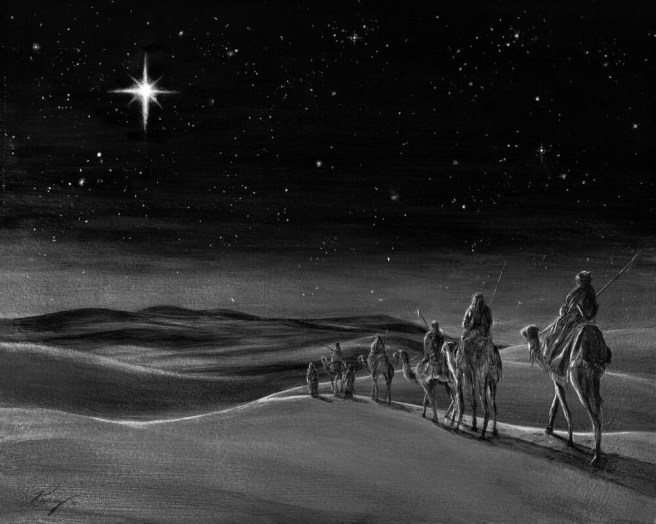
In the Biblical narrative of Jesus’ birth, we see that wise men came from the east bearing gifts for the Christ-child. We see images of them displayed at Christmas time on Nativity scenes and in plays. We sing Christmas carols about them. One of my favorite Christmas pastimes is watching the 80’s classic, Will Vinton’s Claymation Christmas in which the Wisemen’s camels sing “We Three Kings.” But, who are these “wise men”? Were they kings? What can we know about them? Here, I’ll seek to address these questions as well as some common misconceptions we may have about them.
In Matthew 2, we are told the story of how “Magi from the east came to Jerusalem”. They were looking for Jesus that they may worship Him. From here we can see that they knew somehow, where to find Jesus and that he was someone to be worshiped when they did find Him. Where did they come from and how did they know where to go?
The word “magi” comes from the Greek word magos from which we get the word magic. The Blue Letter Bible app defines magos as:
- the name given by the Babylonians (Chaldeans), Medes, Persians, and others, to the wise men, teachers, priests, physicians, astrologers, seers, interpreters of dreams, augers, soothsayers, sorcerers etc
- the oriental wise men (astrologers) who, having discovered by the rising of a remarkable star that the Messiah had just been born, came to Jerusalem to worship him
While the word “magos” is used in Acts 13:8 concerning a sorcerer, in the context of the Nativity narrative “astrologers” probably fits as a good descriptor. They probably came from as close as Babylon (Iraq) or far as Persia (modern day Iran, Pakistan, Afghanistan) when they saw a particular star in the sky. As astrologers they were looking to the stars for signs of different events and were aware that this star ushered in a most significant event of world history.
Dr. Michael Molnar believes the star was actually the planet Jupiter that aligned with the constellation Aries. At the time Jupiter represented a new king and Aries represented Judea. The Magi would have seen this unique heavenly display to the west of them and would have recognized it as being of major importance. However, I think this view has some problems and I’ll address them another time.
I believe it was also familiarity with Hebrew prophecies that drew the Magi to seek out the newborn King. Several hundred years before the birth of Christ, the prophet Daniel was made “chief over all the wise men” of Babylon (Daniel 2:48). Being chief, he would have taught them the writings of prophets like Isaiah who foretold of the coming King. They would also have known of Daniel’s “70 weeks” prophecy in Daniel chapter 9 which some believe predicts the exact timeline for the birth of Jesus, His baptism, and death.
The Bible also says these wise men came with gifts for the newborn King. Gifts of gold, frankincense, and myrrh. Because of the three gifts being represented, it has been assumed that there were only three wise men. However, the Bible never states the number. All we know is that there were multiple wise men. They chose these specific gifts because they understood that Jesus was to be king so they brought gold. The frankincense symbolized His deity and priesthood. The myrrh was used for anointing and embalming. Jesus being our Prophet, Priest, and King is represented in these three gifts. They also have prophetic meaning in that Jesus is King, God on earth, and the Suffering Servant the prophet Isaiah foretold of that would die for the sins of His people.
So while the Bible doesn’t give us numbers or names of these “wise men” we do know they sought to worship baby Jesus. Other than the incarnation itself, this may be Jesus’ first miracle in the flesh; bringing “magicians” or “priests” of foreign religions to worship Him. Here He is already showing His power and supremacy over all nations. He was proclaimed King by Gentiles at His birth and He was proclaimed King by Gentiles nearing His death.

The wise men were wise in that they sought till they found. God met them where they were at and thus they knew they had to respond. If God is calling you today, He is meeting you where you are at to move you to a place He will guide you. Like the Magi, God is taking you to His Son. If in reading this you feel led to get to know the Savior of the world, that is God calling you. Respond to God and He will direct you.
They presented themselves to him: they fell down, and worshiped him. We do not read that they gave such honor to Herod, though he was in the height of his royal grandeur; but to this babe they gave this honor, not only as to a king (then they would have done the same to Herod), but as to a God. Note, All that have found Christ fall down before him; they adore him, and submit themselves to him. He is thy Lord, and worship thou him. It will be the wisdom of the wisest of men, and by this it will appear they know Christ, and understand themselves and their true interests, if they be humble, faithful worshipers of the Lord Jesus. – Matthew Henry
Derrick Stokes
Theologetics.org

 Theologetics.org