Jesus, the Bible, the Quran, and the Law of Non-Contradiction

Empty Tomb
Author: Doré, Gustave, 1832-1883 Image Title: Angel at the Door of the Sepulchre, woodcut

The Law of Non-Contradiction states that

(A) cannot be both (A) and (non-A) simultaneously.

It is logical to have different aspects of (A), but not contradictory aspects.
Example: John is a father. John is in New York. These are different aspects of the same person. However, logic demands that John cannot be in New York and not be in New York at the same time. This would be contradictory. This goes against logic.

According to the Bible, Jesus died a public death on the cross and rose three days later. All four Gospels testify to the crucifixion referenced below but for the sake of time we will look at John specifically:

Matthew 27:45-60
Mark 15:33-39
Luke 23:44-49

John 19:16-33
16. Finally Pilate handed him over to them to be crucified. So the soldiers took charge of Jesus.
17. Carrying his own cross, he went out to the place of the Skull (which in Aramaic is called Golgotha).
18. There they crucified him, and with him two others—one on each side and Jesus in the middle.
19. Pilate had a notice prepared and fastened to the cross. It read: Jesus of Nazareth, the king of the Jews.
20. Many of the Jews read this sign, for the place where Jesus was crucified was near the city, and the sign was written in Aramaic, Latin and Greek.
21. The chief priests of the Jews protested to Pilate, “Do not write ‘The King of the Jews,’ but that this man claimed to be king of the Jews.”
22. Pilate answered, “What I have written, I have written.”
23. When the soldiers crucified Jesus, they took his clothes, dividing them into four shares, one for each of them, with the undergarment remaining. This garment was seamless, woven in one piece from top to bottom.
24. “Let’s not tear it,” they said to one another. “Let’s decide by lot who will get it.” This happened that the scripture might be fulfilled that said, “They divided my clothes among them and cast lots for my garment.” So this is what the soldiers did.
25. Near the cross of Jesus stood his mother, his mother’s sister, Mary the wife of Clopas, and Mary Magdalene.
26. When Jesus saw his mother there, and the disciple whom he loved standing nearby, he said to her, “Woman, here is your son,”
27. and to the disciple, “Here is your mother.” From that time on, this disciple took her into his home.
28. Later, knowing that everything had now been finished, and so that Scripture would be fulfilled, Jesus said, “I am thirsty.”
29. A jar of wine vinegar was there, so they soaked a sponge in it, put the sponge on a stalk of the hyssop plant, and lifted it to Jesus’ lips.
30. When he had received the drink, Jesus said, “It is finished.” With that, he bowed his head and gave up his spirit.
31. Now it was the day of Preparation, and the next day was to be a special Sabbath. Because the Jewish leaders did not want the bodies left on the crosses during the Sabbath, they asked Pilate to have the legs broken and the bodies taken down.
32. The soldiers therefore came and broke the legs of the first man who had been crucified with Jesus, and then those of the other.
33. But when they came to Jesus and found that he was already dead, they did not break his legs.

As you can see, according to the Gospels, Jesus died. In addition to this the Bible is clear on the importance of Christ’s death, resurrection, and ascent into heaven:

1 Corinthians 15 & 1 Timothy 3:16-17

In Islam, the Quran mentions Jesus more than any other Prophet. It states He was born of a virgin (Surah 19), had disciples (5:111-115), ascended into heaven (4:158), and will return as a sign of the end times (43:61). However, unlike the Bible, the Quran states that Jesus did not die:

Quran 4:157-158
That they said (in boast), “We killed Christ Jesus the son of Mary, the Messenger of Allah”;- but they killed him not, nor crucified him, but so it was made to appear to them, and those who differ therein are full of doubts, with no (certain) knowledge, but only conjecture to follow, for of a surety they killed him not:-
Nay, Allah raised him up unto Himself; and Allah is Exalted in Power, Wise;

Now, we go back to the logic stated at the beginning. (A) cannot be both (A) and (non-A). Both can’t be true. Here, we have the Bible (particularly the Gospels) stating Jesus died and the Quran stating that He didn’t. Both cannot be true.

But wait, the Quran makes a couple other very important claims.
–God sent the Gospels

3:3
It is He Who sent down to thee (step by step), in truth, the Book, confirming what went before it; and He sent down the Law (of Moses) and the Gospel (of Jesus) before this, as a guide to mankind, and He sent down the criterion (of judgment between right and wrong)
5:46
And in their footsteps We sent Jesus the son of Mary, confirming the Law that had come before him: We sent him the Gospel: therein was guidance and light, and confirmation of the Law that had come before him: a guidance and an admonition to those who fear Allah,

— The word God sends cannot be changed (corrupted)

6:34
Rejected were the messengers before thee: with patience and constancy they bore their rejection and their wrongs, until Our aid did reach them: there is none that can alter the words (and decrees) of Allah. Already hast thou received some account of those messengers,

Yet, Muslims believe that the Gospels have been altered to show that Jesus died.

What can we say then? The last of the four Gospels, John, can be dated around 80 A.D. The Quran is dated 570 years later at around 650 A.D.

Jesus either did die or didn’t die. Both books can’t be right on this subject. However, looking at the Gospels and what the Quran teaches about the Gospels, the only logical conclusion on the matter is Jesus was crucified. Both texts affirm it when logic is applied!

So let us recount the sequence of events:

Logic: (A) cannot be both (A) and (non-A) simultaneously
The Gospels attest to Jesus dying on the cross
While Quran 4:157-158 says that Jesus did not die
But Quran 3:3 & 5:46 says God sent the Gospels
And Quran 6:34 states the word God sends cannot be changed (corrupted)
So we are left with two conclusions:

1. If the Quran is right about Jesus not being crucified, this would mean it is wrong about God’s word being incorruptible, so the Quran itself loses credibility since it states the Gospels and the Quran were both sent by God.

or

2. The Quran, which was written over half a millennium after the Gospels, is simply wrong about Jesus not dying because it changed the account of Christ’s death and resurrection.

If both texts logically affirm the Gospels; and the Gospels state Jesus died a public death, was buried, and raised on the third day, we have one more reason to believe in the authority of the Christian scriptures. We have more reason to place our faith in the atoning work of Jesus, the Son of God!

In his book, AT THE MASTER’S FEET, Sadhu Sundar Singh, Christian missionary, imagines a conversation between a disciple and Jesus in which Jesus says:

The cross is the key to heaven. At the moment when by My baptism I took the cross upon My shoulders for the sake of sinners, heaven was opened, and by means of My thirty-three years bearing of the cross and by death upon it, heaven, which by reason of sin was closed to believers, was for ever opened to them.

By Derrick Stokes
Theologetics.org

The Hidden “Verse” about Jesus in Genesis 5

Jesus
Christ Crucified between the Two Thieves: The Three Crosses Rembrandt (Rembrandt van Rijn) (Dutch, 1606–1669) Drypoint, engraving, and scraping; fourth state of five Gift of Felix M. Warburg and his family, 1941 (41.1.33)

The more I learn about God’s Word, the more I stand in awe at how amazing God is. To think, that the book of Genesis, a book written over 1,400 years before Christ was even born, contains specific information about God’s plan to redeem the world by sending his only Son Jesus, it is simply incredible.

This is a subtle foreshadowing of Jesus in Genesis 5, I first heard about this subtlety in a short YouTube video which is linked at the bottom of this article. Now it should be noted that Hebrew cannot be perfectly translated into English, or any language for that matter, so some may disagree on the definitions presented but each one is a definition of the name or the idea behind the name, so I feel the following is pretty amazing!

In Genesis 5 the genealogy from Adam to Noah and a meaning of each name in English is as follows:

1. Adam = Man
2. Seth = Appointed
3. Enosh = Mortal
4. Cainan = Sorrow
5. Mahalalel = The Blessed God
6. Jared = Shall come down
7. Enoch = Teaching
8. Methuselah = His death shall bring
9. Lamech = The despairing
10. Noah = Rest

Some names have multiple meanings and roots but one translation of each of the ten names, one name after the other reads:

Man Appointed Mortal Sorrow,
The Blessed God Shall come down Teaching,
His death shall bring The despairing, Rest

So there you have it. The story of Jesus in the 5th chapter of Genesis. These names, starting with Adam from the beginning of creation, to Noah around 2,000 years before Jesus was even sent to earth, outline what God had planned all along to get his children back. Not only that, but this is another example of Christ’s divinity.

I believe that God has a reason for every single word in the Bible, every period and every comma, on more dimensions than we can even imagine. Because of that, I believe the ideas behind these names can be translated this way for a reason, and that reason was to show the world in yet another context, that God loves us so much that he gave his One and only Son to save us from our sin!

1. http://www.abarim-publications.com/Meaning/Adam.html#.VjxQaKSlr7s
2. http://www.abarim-publications.com/Meaning/Seth.html#.Vjw8E6Slr7s
3. http://www.abarim-publications.com/Meaning/Enosh.html#.VjxH26Slr7s
4. http://www.abarim-publications.com/Meaning/Cainan.html#.VjxHyKSlr7s
5. http://www.abarim-publications.com/Meaning/Mahalalel.html#.VjxIWqSlr7s
6. http://www.abarim-publications.com/Meaning/Jared.html#.VjxI8aSlr7s
7. http://www.abarim-publications.com/Meaning/Enoch.html#.VjxOraSlr7s
8. http://www.abarim-publications.com/Meaning/Methuselah.html#.VjxPQqSlr7s
9. http://www.abarim-publications.com/Meaning/Lamech.html#.VjxUrKSlr7s
10. http://www.abarim-publications.com/Meaning/Noah.html#.VjxQBaSlr7s

http://www.youtube.com/watch?v=WsPhPldS6ys

Is Theology and Apologetics Really That Important?

marshill
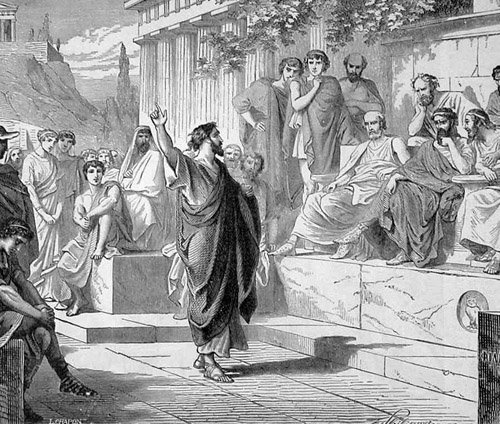
Saint Paul Preaching on Mars Hill (19th century). T. Shilippoteaux. Engraving. © The Provincial Museum of Alberta. PMA:J99.1968.

“Can’t we just read the Bible and worship God without getting all technical?”

Theology is the study of God and is very important. It helps us to understand the God to whom we are worshiping. Proper worship is based on an accurate understanding of who God is. Anytime anyone says anything about God, what is said is something doctrinal. Theology shapes our image of God and if a person’s theology is false then his or her image of God will also be false, which would ultimately lead to idolatry.

In math, the proper answer will proceed from a proper path.

1 + 2 + 3 + 4 = 10

In the same way a proper understanding of who God is, what He would do, and what He wouldn’t do; will inform our doxology (praise) and better guide our prayers.

“Are all these big words and facts really that important?”

For salvation? No. Salvation is not found in head knowledge. However, knowing who God is will help us appreciate Him more, understand the Bible better, and also help us discern false teaching.

Often times we have conversations with family, friends, co-workers, church members, and strangers about God or the Bible. At this point you have just assumed the position of theologian. Apologetics, is the term for defending biblical and theological truths. When these discussions become debates or if you’re just defending you position, you have become an apologist. The more “tools” you have in your mental “toolbox” the better equipped you are to make a defense.

“What about witnessing, isn’t it true that arguing will often just hurt your witness?”

Actually no. If a Christian is just trying to win an argument then he or she will probably do more harm than good but if we allow the Holy Spirit to use the knowledge we have to change a non-believer’s false beliefs about the Bible, Christianity, and God, ultimately this head knowledge can make a huge difference in that person’s heart.

With that said, as Christians, we need to make sure the reasoning we use is sound and that we don’t jump on any “bandwagons” when it comes to modern scientific discoveries. Any scientific argument we use to show that the Bible is accurate could one day be shown to be different or even false, and what the Bible was actually saying may be quite different than what we originally thought but the mistake is not apologetics itself, it would be putting too much trust in man’s knowledge and not enough in the Bible.

An example of this is that through false assumptions and faulty dating methods, many modern scientists believe human life has evolved from smaller and less complex lifeforms over millions of years. While it is quite clear in the Bible that this is not the case and it can even be logically and scientifically shown to be false, there are many Christians who have tried to make the argument that God used evolution to create life. By “jumping on that bandwagon” and taking that stance, it actually weakens the validity of God’s Word because God clearly said in Genesis (written as a historical narrative) that he created everything in the universe in 6 literal days. So when a Christian’s argument becomes making the literal in the Bible something figurative, the Bible becomes a fairy tale instead of something real and that is very sad and dangerous.

I would be remiss if I did not include several disclaimers:

  1. Knowledge of God does not equal a relationship with God. Reading a famous person’s autobiography does not mean you had any kind of relationship with them.
  2. Rebutting objections does not equal evangelism. The goal should be to move someone towards the Gospel.
  3. Head knowledge without the knowledge and guidance of the Holy Spirit can lead to haughtiness and pride. You’re not required to attend each argument you’re invited to. Sometimes the Spirit will move you to be quiet even though you’re knowledgeable on the subject. Sometimes the humble unlearned person will gain spiritual insight and uncanny knowledge when they haven’t been taught by any human. Remember “God apposes the proud but gives grace to the humble.” (James 4:6)
  4. If you read this and want to know more about Jesus, please send us an email at Theologetics3.15@gmail.com we would love to talk with you!