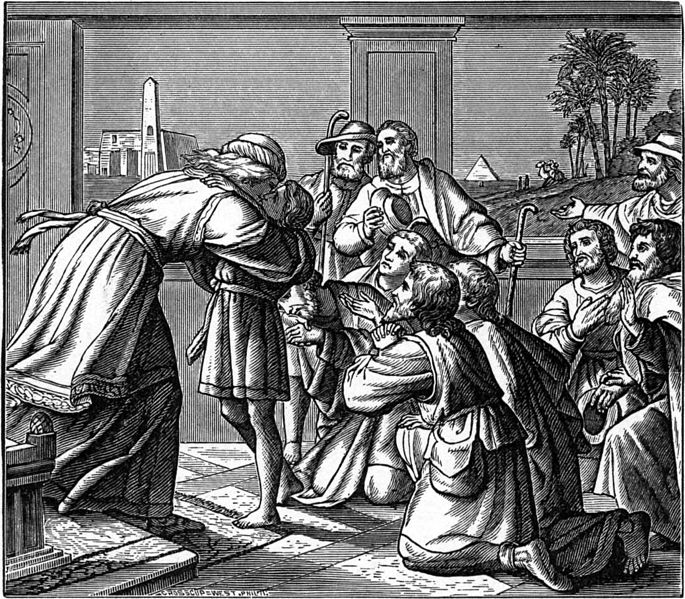
Joseph Kissing His Brother Benjamin by Charles Foster, 1897
2 Corinthians 6:18 “I will be a Father to you, and you shall be my son’s and daughters, says the LORD Almighty.”
In the book of Genesis, Jacob (who’s name was changed to Israel), became the father of 12 sons and a daughter. His 12 sons became the 12 tribes of Israel. They are listed here in order of birth:
Reuben
Simeon
Levi
Judah
Dan
Naphtali
Gad
Asher
Issachar
Zebulun
Josheph
Benjamin
The familiar story of Joseph, Israel’s favorite and unique child (Gen 37:3), tells how he became exhaulted over his brothers and elevated to the highest position in the land under the king. Joseph is an early type and foreshadowing of Christ.
In chapter 41 Joseph has two sons Ephraim and Mennaseh by his Egyptian wife. After Joseph’s family joined him in Egypt, his father Israel, blessed Ephraim and Mannaseh. But he did something peculiar. He didn’t just bless them as his grandchildren. His blessing was bestowed on them as though they were his own sons.
Genesis 48:5-6 And now your two sons, Ephraim and Manasseh, who were born to you in the land of Egypt before I came to you in Egypt, are mine; as Reuben and Simeon, they shall be mine. Your offspring whom you beget after them shall be yours; they will be called by the name of their brothers in their inheritance.
Notice how Israel spoke Ephraim and Manasseh compared to his first two sons. They will be just as important as the first born sons of Israel. Not only just as important, but Israel claims them as his own children.
In theology we have what is known as the doctrine of adoption. Jesus Christ being the firstborn of God (Colossians 1:15), those who are adopted by God through faith become sons of God or “co-heirs with Christ”.
Romans 8:14-17 “For as many as are led by the Spirit of God, these are sons of God. For you did not receive the spirit of bondage again to fear, but you received the Spirit of adoption by whom we cry out, “Abba, Father.” The Spirit Himself bears witness with our spirit that we are children of God, and if children, then heirs—heirs of God and joint heirs with Christ, if indeed we suffer with Him, that we may also be glorified together.”
Like Joseph’s children born of foreign land, we Gentiles were also born as foreigners of Israel. But, through Christ we have access to the Father, like Ephraim and Manasseh had through Joseph. As we read in Ephesians 5:1, “He predestined us to adoption as sonsthrough Jesus Christ to Himself, according to the kind intention of His will.”
John 1:12 says “But as many as received Him, to them He gave the right to become children of God, even to those who believe in His name.”
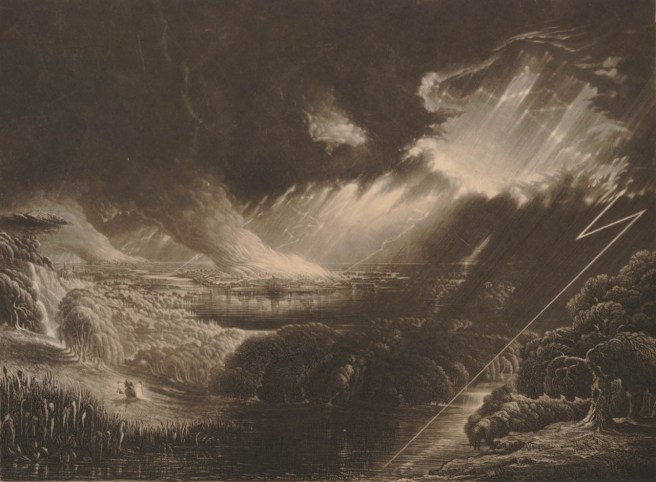
The Fourth Day of Creation (woodcut by Julius Schnorr von Carolsfeld from the 1860 Die Bibel in Bildern)
Isaiah was inspired by God to write the book of Isaiah in the Bible and it is a book that has many prophecies in it, many of which Jesus fulfilled with His life and death which we won’t go into now. Now there are many arguments circulating today that attempt to disprove the Bible. Some have obvious flaws while others may take knowledge about the original language, Biblical history or theology to show their flaws. The Bible claims to be the inspired word of God, written by men which God used to tell us the story of His plan for all mankind. It is without error in its original writings and because of these claims, if they were not true, the Bible would have errors and could be shown to be false. One argument that I have personally come across is that Isaiah believed the earth was flat.
There are at least two verses which have been used to make this claim so lets look at the first verse.
It is He who sits above the circle of the earth, And its inhabitants are like grasshoppers, Who stretches out the heavens like a curtain, And spreads them out like a tent to dwell in. Isaiah 40:22 (NKJV)
Now the argument used for this verse is that if Isaiah knew the earth was a globe at the time he penned the book of Isaiah, he would have used a word like “globe” or “ball” but he used “circle” which is two dimensional and flat.
Now lets look at the second verse.
He will set up a banner for the nations, And will assemble the outcasts of Israel, And gather together the dispersed of Judah From the four corners of the earth. Isaiah 11:12 (NKJV)
The argument used for this verse is that Isaiah didn’t believe the earth was a sphere but that it was a flat square or rectangle with four corners.
For someone to say Isaiah believed the earth was flat based on these verses alone would likely require an eisegesis of the text rather than an exegesis which means the person making the claim is imposing his or her interpretation onto the text instead of drawing out the meaning in accordance with the context.
It is more likely these two arguments are both false and one reason why is that they were both written by Isaiah. Why would the same person write about the earth being a flat square and a flat circle? It is more likely Isaiah didn’t believe the earth was flat at all. When he wrote of the four corners of the earth, Jewish readers would have understood he was speaking about ‘everywhere on the earth’ or ‘from all directions’ which among other things is briefly discussed here http://creation.com/are-biblical-creationists-cornered-a-response-to-dr-jp-moreland.
And the circle of the earth could have meant a sphere. The original word in Hebrew was chuwg which can mean circle, circuit, compass and one translation cites sphere but even if it didn’t, from a distance (like the earth from space) a sphere would be viewed as a circle from all directions so using a word that means circle logically does not negate the earth being a sphere.
So, while there are some seemingly convincing arguments out there that attempt to disprove the Bible, a closer examination will show that the Bible is what it claims to be; the Inspired Word of God!
Jonah and the whale (Jonah 2:11) by Matthaeus Merian I (1630)
I was doing some reading in a new book my wife got me which gives background information about every book in the Bible as well as the Apocrypha. Despite a wealth of interesting and be it “sound” information, are some things which I found a little less than accurate. One of these things is that it states there was only one prophecy in Jonah and it didn’t come true.
So lets take a look at this prophecy.
Jonah 3:4 says Jonah began by going a day’s journey into the city, proclaiming, “Forty more days and Nineveh will be overthrown.”
Another translation is: On the day Jonah entered the city, he shouted to the crowds: “Forty days from now Nineveh will be destroyed!”
So what’s the issue? Nineveh was never destroyed because the people repented and turned from their evil ways.
Well, having a prophet of God get a prophecy wrong would essentially mean God misspoke, or at the very least, Jonah did which would mean the Bible was possibly wrong in relaying God’s intent which comes with a whole new set of issues.
Well, it turns out the original word in Hebrew for overthrown is “haphak” and it can also mean “to turn, turn around, to change and transform”.
So amazingly, because of the Hebrew language and God’s Omniscience, God used Jonah in a way I never even realized. The overthrowing of Nineveh by their destruction turned into the transforming of the city by turning from their sin!!!
It’s astounding how this one word “haphak”, and this one prophecy, could mean two seperate options at the same time which were dependent on the reaction of a city to God’s prophet. The more I learn about the God we serve, the more I am amazed and the more I fall in love with His heart for us.
If you too want to learn more about the God of the Bible, email us at Theologetics3.15@gmail.com
ARRIVAL OF THE GOOD SAMARITAN AT THE INN by Gustave Dore, 1885
“A just law is a man-made code that squares with the moral law or the law of God.” -Dr. Martin Luther King, LETTER FROM BIRMINGHAM JAIL
“This true law diffused among all men, is immutable and eternal.” -Cicero, DE LEGIBUS
In a previous blog defending the unborn, I mentioned that saving a life isn’t just an argument from the religious among us. That there are non-religious people who also affirm that abortion is immoral. But what makes something immoral?
The concept of moral subjectivity says that morality is subject, or relative, depending on the person, culture, or time frame. What may be considered morally right for you may not be for me. Or what was considered morally right in the past is not so now.
Absolute morality states morality is the same for all people of all time. It’s not what is considered moral or immoral; it’s that morality is an actual thing that transcends human perceptions.
In this video (at 6 minutes and 30 seconds in) a moral relativist gives this syllogism: a) If morality is objective, then we would all have the same view of morality. b) If we all had the same view of morality, then we would never disagree about what is moral. c) We do disagree about what is moral. Conclusion) Therefore morality is not objective.
Premise “a” is false. A person can believe 2+2=5 and another believe that it equals 4. One person can believe the earth is flat and another believe it is round. So just because someone has different views doesn’t mean the truth isn’t objective. The same logic can be applied to morality.
The fallacy in premise “a” makes the logic in the rest of the argument fall part. People can and do disagree about what has already proven to be true. Disagreeing about facts doesn’t make the facts any less factual. It doesn’t make truth relative.
You may argue that we cannot compare objective truths like laws of mathematics to something as abstract as morality. But the truth is: morality is just as objective.
Some skeptics argue that God cannot be the standard for morality because of some of His actions in the Bible. What must be noted however is that the skeptic, often a moral relativist, is making a morally objective claim. They claim that the actions of Yahweh are not moral.
But where do they get their standard of morality from? Is it just a matter of individual taste? Is it a matter of societal conditioning? Is it something deeper?
If morality is truly subjective then a person cannot claim that God or anyone else is wrong for what they view as moral or immoral. If I stole your wallet, then you could only say that stealing wallets is wrong for you and that my views are just as valid as yours. But, reality tells a different story. If I stole your wallet, then you would not believe I am wrong, you would know that I am wrong and you would reasonably expect that I should know it is wrong as well. Every fiber of your being would expect that I should know that it is wrong. Therefore, you wouldn’t be indifferent to the theft, you would be angry at the thief. And rightfully so.
In Mere Christianity, chapter 3, C.S. Lewis states there is a difference in the Law of Nature and his Law of Human Nature. The law of nature describes what things do, like a rock falling because of gravity. The Law of Human Nature (or the Moral Law) describes what a person ought to do, regarding ethics and morality. “I am not angry – except perhaps for a moment before I come to my senses – with a man who trips me up by accident; I am angry with a man who tries to trip me up even if he does not succeed. Yet the first has hurt me and the second has not. Sometimes the behavior which I call bad is not inconvenient to me at all, but the very opposite.”
He further states, “If we ask: ‘Why ought I to be unselfish?’ and you reply ‘Because it is good for society’ we may then ask, ‘Why should I care what’s good for society except when it happens to pay me personally?’ and then you will have to say, ‘Because you ought to be unselfish’ – which simply brings us back to where we started. You are saying what is true but you are not getting any further… If a man asks what is the point of behaving decently, it is no good replying, ‘in order to benefit society,’ for trying to benefit society, in other words being unselfish (for ‘society’ after all only means ‘other people’), is one of the things decent behaviour consists in; all you are really saying is that decent behaviour is decent behaviour. You would have said just as much if you had stopped at the statement, ‘Men ought to be unselfish.’ And that is where I do stop. Men ought to be unselfish; ought to be fair. Not that men are unselfish, not that they like being unselfish, but that they ought to be.”
Are your feelings the standard? No. There is a standard that you know exists outside of yourself. A standard of how we know we “ought” to act. And others are expected to know this standard also.
“Well, of course. The law of the land and accepted human behavior is the standard. And the law says stealing is wrong,” you may argue. Then, by that same logic, you cannot argue against the Atlantic Slave Trade, the Holocaust in Nazi Germany, the Spanish Inquisition, the Crusades, or any other historical events once deemed lawful.
“Well, I can argue against those because they were crimes being committed against humanity.” So what you’re now saying is that they were violating a moral standard that transcends cultures, nations, and centuries.
We see that we know morality is a real thing that exists outside of ourselves. It is observed by us and known by us but it is a thing outside of us. It is set by a standard that we know we should behave by.
So what is the standard? Does it change?
18th century philosopher, Immanuel Kant, believed that morality was not subjective but rather objective. That it was an axiom of the metaphysical world. He stated “I ought never to act except in such a way that I could also will that my maxim should become a universal law.” He called this the Categorical Imperative. In other words “Act in a way that all of mankind would benefit if we were to treat each other the same way.” It wouldn’t be ok for everyone to start stealing from each other, so its not ok for one person. Or as Jesus said 1700 years before, “Do unto others as you would have them do unto you.”
Atheist, Sam Harris said here, “It [the world] needs people like ourselves to admit that there are rightand wrong answers to questions of human flourishing, and morality relates to that domain of facts…” He believes that there is an objective morality. What sets him apart from the Christian worldview is what he believes to be the source of this morality.
According to the atheist, humanity is just a higher evolved species in the animal kingdom. But logic tell us that animals do not act in moral or immoral ways. Each animal just does what is best for his own survival. According to naturalistic atheism, morality is just a construct of evolution; making humans the final authority on what constitutes as morals. So, who then decides? The most powerful? The most logical? The richest? History tells us that these qualifications are still flawed standards for morality.
Our position is that objective morality points to the existence of God.
Because there is a moral law, there must be a Moral Law Giver. God is that moral law Giver. He is the standard and has given us the law. And this law is written on our hearts.
In Matthew 22:37-40, Jesus said that the whole law is summed up as “You shall love the Lord your GOD with all your heart and all your soul and all your mind. This is the great and first commandment. And the second is like it: You shall love your neighbor as yourself. On these two commandments depend all the law and the prophets.” The first four of “the law” (the 10 Commandments in Exodus 20) are of the love of God and the last six are of the love for our fellow man.
What’s important to note is that cultures during different periods of time and in other societies have had similar commands or standards for ethical living. Here are some illustrations:
“I have not slain men” Confession of the Righteous Soul. Ancient Egypt (against murder)
“I saw in Nastrond (Hell) beguilers of others’ wives.” Volospa. Old Norse (against adultery)
“I sought no trickery nor swore false oaths.” Beowulf. Anglo Saxon (against lying)
“Choose loss rather than shameful gains.” Ancient Greece (against stealing)
“Utter not a word by which anyone could be wounded” Law of Manu. Ancient India (against insults)
“You will see them take care of…widows, orphans, and old men, never reproaching them.” Native American (showing charity [love])
This is proof of what Paul tells us in the second chapter of Romans; that even people who do not have the Law written, have the law instinctively. “For when Gentiles, who do not have the law, by nature do what the law requires, they are a law to themselves, even though they do not have the law.” (verse 14)
Moral laws are instilled in us because we are created in the image of God. Like God, we love what is good and hate was is evil. God loves what is good because He is good. Goodness is one of His attributes. There is no goodness aside from God. However because of our sinful, fallen nature we often disagree on what is good and what is evil. But the truth remains, we know there is a standard of goodness that transcends time and culture. This Standard is God.
MOSES SPEAKS TO ISRAEL, by Henri Felix Emmanuel Phillippoteaux
“The Shema is the central prayer in the Jewish prayer book. It is generally one of the first prayers a Jewish child learns. The Shema defines what it means to be Jewish as it has since the days of Moses:
Shema Yisrael Adonai Eloheinu Adonai Echad—“Hear, O Israel: The LORD our God, the LORD is one” (Deuteronomy 6:4).”
If the the Shema states that God is one, doesn’t that contradict the Christian doctrine of the Trinity?
If the LORD is One, then how can He be also Three? The word “echad” (the ch is more of a throaty h sound) in the above verse is the Hebrew word for one. But, if we believe God is a Trinity how do we reconcile this apparent contradiction?
Well, in Genesis 2:24 the same word “echad” is used to describe how a husband and wife will become one flesh.
In Genesis 11:6, the tower of Babel narrative describes the people as being one (echad).
Ezra 2:64 the whole assembly is gathered together (echad). But the people in the assembly numbered 42,360. In these verses, echad represents a unified oneness, not a numerical oneness.
Now, I can’t say that echad always represents a unified oneness. Sometimes it can represent a numerical oneness (Ex. Numbers 13:2, Deut.17:6) . So how do we know the difference?
As usual, the answer lies in the context. The word for God in the Shema is plural אֱלֹהִים (‘Elohiym). Just like Genesis 2:24, chapter 11 verse 6, Ezra 2:64, and others not listed here, echad means a compound unity.
You will see the word Eloheinu above and perhaps think that’s different than the plural Elohiym. The only difference is Eloheinu means “Our God” but the root word is still the plural word Elohiym.
Therefore, we see that even before the Trinity was understood as we understand it today, the Hebrews of the Old Testament understood there was a vastness and complexity to the Godhead. The very first word used for God in the Bible (Genesis 1:1) is the plural word Elohiym.
So there is no contradiction. God does not change (Malachi 3:6).
Psalm 102:25-27
“In the beginning You laid the foundations of the earth, and the heavens are the work of Your hands.They will perish, but You remain; they will all wear out like a garment. Like clothing You will change them and they will be discarded. But You remain the same, and Your years will never end.”
The Pantheon, a temple in Rome dedicated to “every god”, completed in 128 A.D.
There’s a popular quote by atheist Steven F. Roberts that many nonbelievers cite or paraphrase when debating Christians that says, “I contend we are both atheists. I just believe in one fewer God than you do.”
The atheist is saying that since we Christians don’t believe in Baal, Zeus, Odin, Vishnu, Quetzalcoatl, or any other god other than the God of the Bible, then we assume the same lack of belief system. They just take it one deity further.
So what’s the difference ?
Well it doesn’t take much to realize that this argument is constructed in a way to throw the believer off guard. Let’s look at the two members of the argument. An atheist and a theist. The word atheist comes from the Greek atheos. The prefix a meaning “without” and theos meaning “god”. In other words atheism is the belief that there is no god or gods. No Supreme Ruler whatsoever. The atheist’s worldview is completely shrouded and perceived in the material realm. That anything outside it is pure speculation and unprovable (or not proven yet).
However, for the theist (Christian in our case) the material realm is just another dimension of reality. For us there is also the spiritual realm. The spiritual realm is, in fact, the truest reality because it existed first. God is spirit (John 4:24) and He created all that exists (Genesis 1, John 1:3) in the spiritual and material world.
Now let me point out that Christians during the 1st century were called atheists because they rejected the pantheon of greco-roman gods of the surrounding culture. This was also because the Christians of the day had no temple, priest, or sacrifice, as Romans would have recognized. Yet, believers in Christ saw Jesus as the temple. He is the only way to the Holy of Holies. Believers in Christ saw Him as priest because He is the Ultimate High Priest. Believers in Christ saw Jesus as the sacrifice because of the work He accomplished on the cross. He is the sacrificial Lamb of God and no sacrifice is needed after Him. (John 1:29; Hebrews 4:14; 10:10-11, 19-20)
After the resurrection of Jesus and the birth of the Church there was no “physical” representation of their God like the Romans had. The Romans had statues and Caesar. If you didn’t worship as they worshipped and whom they worshipped then you worshipped nothing. Therefore, the term atheist was applied to early Christians out of ignorance and out of insult.
In the Martyrdom of Polycarp, Polycarp is brought before the Roman governor for trial. The governor has the intention of making Polycarp betray his Christian brethren. Polycarp must say, “Away with the atheists” or else be condemned. He looks around at “the crowd of lawless heathen”(the pagan Romans) and says “Away with the atheists” flipping the name on to his accusers. (Martyrdom of Polycarp 9:2)
But, let’s be reminded. Atheists reject all gods. They reject false gods and the true God, Yahweh. They don’t just reject one more god than Christians. They reject THE God. The only true and living God. Even though God has made Himself plainly evident through His creation, atheists won’t come to the knowledge of the truth. (Romans 19:21)
However…
Atheists might reject the notion of gods as supernatural, ethereal beings, but they still have gods. We all serve something or someone. We all worship something or someone. Whether it be ourselves, pleasure, fortune, fame, other people, hobbies, pets, nature, gods made of wood or gold, or the God of the Bible; something gets our worship whether we choose to accept the notion or not.
This brings us to the first two commandments:
1)You shall have no other gods before Me [Yahweh]
2)You shall not make for yourself an image in the form of anything in heaven above or on the earth beneath or in the waters below. You shall not bow down to them or worship them. (Exodus 20:3-4a)
If we have broken these commandments, and we all have if God is not who we worship, then we make ourselves idolaters. Anything other than God that gets our worship has become an idol. These are Paul’s words in Philippians 3:18-19
18 For, as I have often told you before and now tell you again even with tears, many live as enemies of the cross of Christ. 19 Their destiny is destruction, their god is their stomach, and their glory is in their shame. Their mind is set on earthly things.
If this is true of you today, please understand that God wants to be the object of your worship. He knows that anything else that competes for your attention above Him is a false god. He knows that no other god can bring you true joy and fulfillment. Anything else is an imitation and will never come close to the perfect love, holiness, and eternality of God. Don’t be blinded by passion for the things of the world. Things will break. Trends will fade. This world and everything in it will pass away. God and His Word are forever. And don’t place any person above God. Human beings are imperfect and all have fallen far short of God’s glory. But, God is not man that He should lie or change His mind. Nor will He ever leave us or forsake us. So, give your worship to God and to God alone because He alone is worthy.
The Destruction of the Cities of the Plain (Lot and his daughters running for cover in foreground. Mezzotint with etching, c.1830s.) ~ by James G S Lucas
So the LGBTQ movement is something that is becoming more and more common and personally affects Christians more than ever before, quite clearly because of the acceptance of the movement in mainstream media.
I have recently wrote about the importance of loving everyone regardless of their race, socioeconomic status, sexual orientation, etc. which can be found HERE but the definition of what that love looks like is very much debated among Christians and everyone else.
As such, I thought it may be helpful for some Christian’s and non-Christians alike for us to outline what we believe at Theologetics.org and why we believe it.
Let’s start by looking at what is at stake. For someone who identifies as being gay or a lesbian, if Christians take a stance against same-sex attraction and these Christians are wrong about it being a sin, the individuals that embrace same-sex attraction will rightly feel ostracized and hurt because what they are identifying as is the same thing many Christians would wrongly be calling a sin. But if Christians stand against homosexuality because it really is something that is wrong, something God condemns, and something that is a hurtful lifestyle, then Christians that lovingly condemn the sin are showing true love to the sinner.
As Christians, it is important for us to realize how deep this goes, many if not all people that embrace same-sex attraction are not just lightly making the decision one day to like the same sex, they had been feeling an attraction for a long time.
Lets take a brief look at the attraction itself. Often it is believed this attraction is something people are born with. While there is not much evidence for that stance, the truth is it really doesn’t matter from a Christian perspective. Some people are born with a disposition for the abuse of alcohol or drugs but that doesn’t make that desire healthy or right. So I would caution Christians or secularists that take a side of the issue using the logic that it is or is not in the genes since the Bible clearly states that we all have sinned and have a sin nature, so genes are not a good measuring stick for this issue or any other for that matter.
So to the Christians reading this I say please be kind, gentle, loving and patient when dealing with this issue as those who are lost need to see Jesus in you more often than hearing about what the Bible says is wrong. Remember, “A gentle answer deflects anger, but harsh words make tempers flare.” Proverbs 15:1
So now, let’s take a quick look at the Bible.
The Bible doesn’t address the issue of homosexuality much but when it does it is clearly condemned as being sin. For the purpose of keeping this blog short I won’t go into the meanings of the verses about homosexuality but for someone that questions what the Bible really says about it being sin, you can find some information on it HERE. Basically there are several ways the Bible is read and how it is read depends on the reader.
In my opinion, the four basic types of Bible readers are:
1. Non-Christians
2. Cultural Christians
3. Non-Fundamentalist Christians
4. Fundamentalist Christians
Non-Christians consider the Bible to be either just another book of many, that it is out-dated or maybe even that it is a bad book. They may believe it has some good ideas or no good ideas but definitely not a book that has any authority over how people should live their lives. As these beliefs are unfounded, it would take at least another separate blog to begin to explain the reasons why but some information about the authority of Scripture can be found as a PDF HERE.
In reality, a Cultural Christian is someone that really follows culture over the Bible regardless if it aligns with the Bible or not. They don’t really read the Bible that often and usually don’t care to either. They may consider themselves a Christian because their parents are Christian, or they were baptized as a child, or something to that effect. A Cultural Christian says one thing and does something else. This is hypocrisy. It is illogical to say you believe something or identify as something but live as though you do not. In reality, many Christians have areas in their lives that they may say they believe what the Bible says but live as though they do not believe it. All who say they follow Christ should examine their hearts in any area of life and truly compare it with what the Bible says regarding that area.
Non-Fundamentalist Christians are among varying denominations and individuals that generally don’t believe in the complete authority of the Bible. They may believe that the Bible is either only partly inspired by God or not at all, or that the inspired word of God has been changed and not to be taken literally today. Similar to Cultural Christians, a Non-Fundamentalist’s belief is also illogical, let me explain.
If I were to believe the Bible is only partially inspired by God, and that some of it are men’s ideas added in, I would have no way of knowing what to really believe is true or not and thus, it would not make sense to put any faith in the Bible at all. The same logic applies if I were to believe the Bible were originally 100% God’s inspired words but that it has since been changed.
Similarly, if I were to believe the Bible was written completely by men, not inspired by God at all, it would have no authority and would just be another book among millions, so calling myself a Christian would really be pointless as all other ideas, religions, and philosophies would have equal merit and truth. (That’s not to say other non-Christian sources of information don not have some truth to them, just that the Bible is the only ancient manuscript that can be shown to be without error in it’s original manuscripts, and divinely inspired with hundreds of fulfilled prophecies. Again, some information about the authority of Scripture can be found as a PDF HERE and other good places to start would be books by Lee Strobel, Ravi Zacharias, C.S. Lewis, and Dan Story)
Which leads to the last type of Bible reader; the Fundamentalist Christian. Fundamentalist Christians believe the Bible is completely inspired by God. They look at context when interpreting the Bible and take it to be literal when the language is not poetic or allegorical. If you claim to be a Christian, this is the most logical way to read the Bible. If you are not a Christian, there are many reasons why you should look into what the Bible really says, specifically about Jesus, and the historical, archeological, theological, and simply logical reasons why the Bible is the inspired Word of God which any of the previously mentioned links and authors are great places to start.
So, if the Bible is completely inspired by God (which the evidence is well in favor of it being so) and the passages that discuss homosexuality are examined in context and taken literally (the most logical way to read and interpret the Bible), homosexuality is clearly found to be a sin.
Anytime anyone chooses sin, they are saying to God that they want to do things their way instead of God’s way. Anytime we try and do things our way leads to pain, sickness, destruction, and death. Being a sin, homosexuality is destructive to those who practice it and thus, the most loving thing Christians can do is lovingly stand against the sin while being loving and like Christ to those who embrace same-sex attraction. This is our stance. I hope this was helpful for those who read it, at least in understanding where many Christians and Christian organizations are coming from when they say they will not compromise on Scripture when it comes to these specific issues of homosexuality.
Treasures of the Bible (Jesus’ Ministry) — Jesus, Walking on the Water, Rescues Peter
A friend of mine recently couldn’t find his youngest boy. He and his wife looked all over their house and once they realized he really wasn’t there, they called the police. This father assumed (and hoped) his son went to a friend’s house without telling them and he planned on yelling at his son and even spanking him on the spot for wandering off when he found him. After an hour of scouring the neighborhood, an hour that felt like an eternity, he finally found him at a neighbor’s house. But in that moment, he couldn’t yell, he couldn’t spank his son like he planned on doing, all he could do was hold him in his arms because he was safe.
He said that he got just a small glimpse of what God feels when one of his lost children is found. That he was shocked that he didn’t react the way he had planned and that his heart was so full of gratitude that the only thing that came out of him was love for his lost son.
Jesus came to this earth to get back what was most precious to God; his lost children.
“his lost children”
But who are his lost children? Who are the ones that are SO precious to God that he would send his only begotten Son to die a horrific death in OUR place just to reconcile us, to save us? Who are the ones that have God’s love, his affection, his heart?
The answer… We ALL are!
Every.
Last.
One of us.
It doesn’t matter what you have done. God loves you. It doesn’t matter what mistakes you have made. God wants you. Not everyone will accept this gift and many will choose to live eternally apart from God and stay lost but regardless, God loves all of us!
So when some in the body of Christ elevate certain sins over others, namely homosexuality, and don’t reach out to those individuals in love because of that sin, they are not only making a mistake but committing sins (plural) themselves.
The sin of hypocrisy. The sin of arrogance. The sin of selfishness…
So if you have gay friends and think you are a Christian, you are truly living like Christ. If you are trying to be a light to those who are lost, you are living the way Christ called all of us to live. We are called to be in the world and not of it. I think the Church focuses on the second half of that verse a little too much sometimes, “not of it.”
Sometimes while trying not to be of the world we forget to be in it.
Don’t get me wrong, we cannot condone sin in any form. Being gay is clearly a sin and should not be celebrated (Leviticus 18:22, Leviticus 20:13, 1 Corinthians 6:9-10, Romans 1:26-28). But those who struggle in that area should be loved, should be befriended and shown that they are important to God. Let them see God in you, not God’s judgment through you, after all, there is not one of us who does not struggle in some area. As I see it, Jesus treated the lost this way, never condoning sin but always loving the sinner. He was the most critical of the religious of His time; the Pharisees, the Sadducees, the religious leaders… Jesus called them “white-washed tombs” (Matthew 23:27) meaning they were hypocrites, self-centered and missing the point of true love. They focused on the law too much and did not love people.
The law is important but it never supersedes God’s love. Love fulfills the law. Like many things in life, you cannot have one or the other, there needs to be a balance of the two. But it seems to me more and more “Christians” in our day are known by the law, not by the love. Again, not to say one replaces the other, just that Jesus was known by His love and I really believe we should too.
So while some celebrate the LGBTQ community and others treat them like they are committing the unforgivable sin, we should open our arms, our hearts, and our homes to EVERYONE in love to show them that they are cherished by us and subsequently, by God. Just maybe that will make the difference in their lives and help open their eyes.
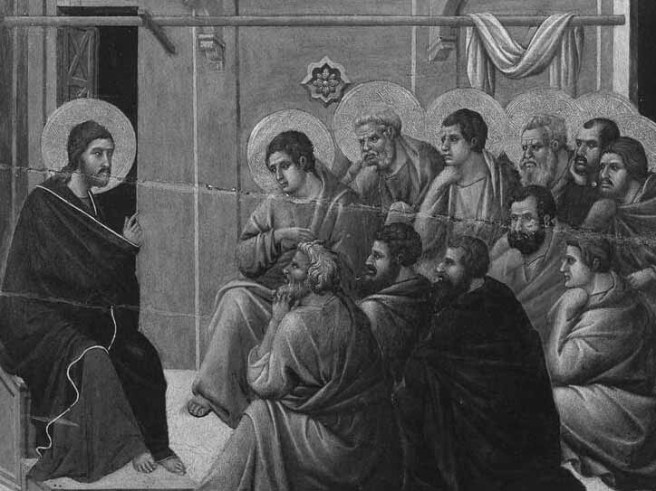
Farewell Discourse from the Maesta by Duccio (1308-1311)
At any given Sunday service, youth retreat, children’s church, Christian concert, etc, there is typically what is known in American Christianity as an “altar call.” It is usually an invitation of those who want to make Jesus Christ their personal Lord and Savior and those who already are Christians but want to rededicate their lives to Him. Some attribute the popularity of alter calls to Billy Graham and his popular crusades. While there is no direct biblical reference to alter calls, I cannot speak negatively of them. Many have come to Christ by the way of altar calls.
I want to talk about what happens after the altar call. I think we falter when we see altar calls as a litmus test of how well a ministry or sermon or gathering is going. We like seeing crowds come to the front. We like knowing that (x) amount of people filled out commitment cards. But there is a danger of a false sense of accomplishment here.
How many of these decisions to come forward were caused by family or peer pressure? How many of these decisions to come forward were based on emotions being drawn by the worship leader? What happens after the music stops? Are these conversions genuine? I’m sure millions are. But, who seeks to pour into spiritual growth afterwards?
In what is known as The Great Commission found in Matthew chapter 28, Jesus commands “Go and make disciples of all nations…” While making converts is vital to the growth of the Church, there has to be a continuous maturing of the believer after that. Otherwise you’re left with large amounts of spiritual infants who, often by no fault of their own, haven’t moved from milk to meat. They were simply a face in a crowd. While the angels were rejoicing at their salvation the elders bragged about the number of hands that were raised.
If a man has been working at a job for 20 years and showed very little knowledge or skill in his work, you might believe something to be very wrong, either with him or the training program. If a man is a Christian for 20 years and can’t name something elementary like the four Gospels and shows very little spiritual fruit, we should be wondering what went wrong. He is spiritually a 20 year old infant.
Wikipedia defines a disciple as a “student”. Merriam Webster defines a disciple as “someone who accepts and helps to spread the teachings of a famous person.” In traditional Chinese, the disciple was a person “who believes in the ideas and principles of someone famous and tries to live the way they do or did.” In the original Greek of Matthew 28, disciple (didaskalos) is a pupil of a master or teacher. The root Latin word that we get disciple from (discipulus) actually means “scholar”.
As we can see the meaning of disciple is far from someone who stays in spiritual infancy. A disciple should be steadily growing in knowledge and holiness. While the Holy Spirit has His part to play, so do other believers. When Jesus called out Lazarus from the dead, he left it up to his family and friends to make sure he didn’t stay in his grave clothes. In other words when we are saved from our spiritually dead selves, it is the responsibility of those who have been waiting and praying over us to help us look like the spiritually awake individuals that we become. This is one reason being an active member of local church is so vital.
I know of many churches that don’t just leave the new believer alone after their conversion. Many send mail, call, or even visit to help ensure the believer is growing. Many churches have discipleship programs where the new believer or even the 20 year old infant can learn to grow in Christ. There are missionaries who don’t just leave the people they find with a new faith but actually ensure the natives they converted learn and grow to become new pastors and teachers. These are the churches and believers that are fulfilling Jesus’ mandate to make disciples.
If you are a new believer or believer who realizes that you haven’t been growing since you got saved, then my advice is to surround yourself with believers who are maturing spiritually. Find a church that encourages Bible reading and group study. And make the time often to study for yourself.
Helping believers grow in knowledge is one of our goals here at Theologetics.org. Every believer must also mature in spiritual fruit. It is our prayer that reading this will cause us to evaluate ourselves and motivate growth in both aspects of your Christian walk.
Applicable verses: Matthew 28:19 Hosea 4:6 Psalm 1:1-3 2 Peter 1:5-6 2 Peter 3:18 2 Corinthians 13:5 Colossians 1:10 Ephesians 4:15 Galatians 5:22-23 Titus 2:1-8 Hebrews 5:12
Do your best to present yourself to God as one approved, a worker who has no need to be ashamed, rightly handling the word of truth– 1 Timothy 2:15
I’ve heard the same story repeated. I’ve even experienced it myself. A Bible Study is underway and the person leading the study will begin by reading a verse or passage. Then he will ask those attending what that scripture means to them. In a group of 10 you might get 10 different answers. This is especially true with more ambiguous or mysterious passages. You might ask “what’s wrong with that? The Bible speaks to everyone differently depending on where you are in your life.” There is some truth to that. But let me provide another perspective:
You write a letter to a loved one. How much of that letter would you expect them to read? It would be safe to assume that the entire letter is to be read. While certain phrases or sentences may stick out in the persons mind, they are to be taken in context with the rest of the letter. If a sentence seems questionable on its own, usually it is the rest of the letter that will make sense of it. It’s all a part of communication. You want the reader to understand what you meant, not for them to inject their own interpretation.
This is how we should come to scripture.
The Bible is a collection of books and letters written to those identified as God’s people. Hermeneutics is the science of rightly interpreting the Bible.
Scripture in its original form did not consist of chapter and verse divisions. To be honest sometimes I wish it still didn’t. But, with such a large book, chapters and verses are helpful for finding the words you need. However, we fail when we pick out a verse without understanding the surrounding text, or context (with the exception of most of Proverbs and Ecclesiastes). Take a verse like Matthew 7:1 “Do not judge lest you be judged,” which many of us take to mean you should never correct anyone in sin or wrong doing. However, a more thorough reading of chapter 7 will explain that we’re not being told NOT to judge. We’re being told that we shouldn’t judge others before we have judged and corrected our selves first (verses 3-5) on the same matter. Some chapters even begin with the adverb “therefore” meaning “for that reason”. Because of this, we should know what was being said in the previous chapter. This will bring new light to the following chapter. Since most books in the Bible are written as narratives or letters, it would greatly benefit the reader to read the entire book other than just a couple of chapters. This can and will bring the better understanding of each verse read.
In the grander scheme, reading the entire Bible can bring better contextual understanding of each of its included books. In regard to Matthew 7:1 we are told over and over throughout the Bible to judge rightly and to use discernment (judging). Making the common phrase “The Bible says not to judge,” erroneous and at best incomplete.
Literary context is only one step in “rightly dividing the word of God.” Duvall and Hayes in their book GRASPING GOD’S WORD, explain how to get a better understanding of scripture in 5 steps they call “The Interpretive Journey”.
Step 1 is called “Grasping the text in their town”. Basically what would the text in question mean to the original readers. How would they have understood it. This can be difficult if there is no general understanding of who the original audience was or how they viewed the world around them. Is the book written as a historical document, poetry, epistle?
Step 2 is measuring the width of the river to cross. In other words what are the differences between the original audiences and myself? What was their culture, language, and situation? Were they under a different covenant?
Step 3. “Crossing the principlizing bridge.” What is the theological principle this text presents? You come to a verse like “A woman must not wear men’s clothing, nor a man wear women’s clothing, for the LORD your God detests anyone who does this” in Deuteronomy 22:5. This isn’t just a commandment forbidding women to wear pants. If we look at the differences in culture as stated in Step 2, we can understand that there were no pants in the culture of the ancient Israelites. So they would have understood it to mean your appearance in general. God made man to be male and woman to be female. The way you present yourself to the world is to either submit to who God made to be or to go against it. Crossdressing could also be a matter of being deceptive.
“Consulting the Biblical map” is Step 4 of the journey. This goes back to using the rest of scripture as context for understanding. Is what I have gathered about this passage in agreement with the rest of scripture? Since God does not contradict Himself nor does He change His mind then if my understanding is contrary to what is explicitly stated elsewhere then it is my understanding that needs to submit to scripture, not the other way around.
The Last step on the journey is “Grasping the text in your own town”. This is where you apply what you have learned in the previous 4 steps to your life and the lives of those around you. How does it apply in my life and culture now?
Biblical exegesis is a process of rightly interpreting. Exegesis is only done through careful and objective study of the text. The opposite of proper exegesis is called eisegesis. Eisegesis is when the reader interprets the text through subjective lenses and makes the scripture mean whatever he wants it to mean.
One way to properly exegete scripture is by studying the original languages it was written in. I’ll give a simple example that many of us have learned in high school. There is a famous scene in Romeo and Juliet where Juliet is seen asking “Romeo, Romeo. Wherefore art though Romeo.” Now in our modern English, that sounds like Juliet is inquiring about the location of her beloved Romeo. But, in the 1500s, when it was written, that phrase would have been understood as “Romeo, Romeo. Why are you Romeo?” Since Romeo and Juliet came from feuding families she was asking why did Romeo have to be Romeo of the family that her family hated. The next line in the poem makes sense of this when she says “Deny thy father…” Therefore, using proper literary and cultural context we gain a better understanding.
Now if we need help understanding a poem written in the same language only a few hundred years ago, how much more so a book written in foreign languages thousands of years ago? Now I’ll use a biblical example to make my point.
In John 21, after Jesus’ resurrection, He asks Peter “Do you love me?” To which Peter responds “Yes Lord; you know that love you.” Jesus asks this question to Peter twice more. And twice more Peter has the same response. Now in the English this may seem like just a conversation about Peter’s love for Jesus, and that would be right. However, the conversation in the original Greek presents Peter answering a somewhat different question than he is being asked. The term love that Jesus is using is the Greek word “agape” meaning an unconditional love. The term for love that Peter uses is the Greek word “phileo” meaning more so a brotherly/friendship type of love. Both still “love” but different verbal expressions and meanings. It is believed that Peter was so ashamed after his 3 denials of Christ that he could not say with confidence that he unconditionally loved his Lord because his zeal turned to fear and he abandoned Jesus.
Back to the scenario being played out in Bible studies around the country. The goal should not be to come away with subjective interpretations of scripture. We can know what the Bible says and what it means when time is taken to properly study it. So to correct this scenario the person leading the study should already have a proper understanding of the text. Yet, he can walk his audience through how he got the understanding of what the original author meant. So, when the time comes to engage the group, they aren’t left with subjective interpretations; they will have an educated understanding of what was meant. What the Author actual meant. The subjective part comes in how each individual with apply it to his or her own life.
Some people ask me how they should begin reading the Bible. It is my personal opinion that starting with the New Testament is the wisest choice. Start at Matthew and read to the end of Revelations. When I began seriously reading the Bible I spent most of my time in the New Testament until I’d read it several times. I suggest the New Testament first because it teaches us what we need to know about salvation and Christian living. Then I say read the Old Testament, Genesis to Malachi. But as you are reading be sure to read each book just like you would a book. Only using chapter and verse divisions as reference points. Write down verses that speak to you (or baffle you) in a notebook for further study. And last but most importantly, always seek the Holy Spirit’s illumination. Reading the Bible without it will lead to confusion, misunderstanding, and misuse.





 Theologetics.org