Why Doesn’t God Forgive Sin Without a Sacrifice?

If God can do anything He wants, why doesn’t he just forgive sin? He’s all-powerful. He’s the epitome of love. So, why did He need a sacrifice for sin? Why doesn’t He just say to everyone, “Poof your sins are forgiven!”

The Return of the Prodigal by Rembrandt

In the beginning, we are told that God gave mankind one rule: don’t eat the forbidden fruit. We only had that one rule. We still disobeyed. God drove man from His earthy temple, Eden, but not before telling them a promise. We’ll get back to that promise later.

Why would God need to send them away, though? Couldn’t He just have said, “I forgive you. Don’t do it again. Stay and enjoy paradise”? Furthermore, later in Scripture, we are told that God requires us to forgive someone who sins against us, and if we don’t, then He won’t forgive our sins. But wait. Why do we have to be the first to forgive? Is that even fair?

Well, I believe that to understand this, we must first understand who God is and who we are in relation to God.

God, who is the most perfect being, created man. Man is not a perfect being. As I stated earlier, the earliest man couldn’t even keep one rule. God is all-powerful (omnipotent), all-knowing (omniscient), and the ultimate goodness (omnibenevolent). Man is none of these things. We can only know so much, do so much, and have a limit on how good we can be. God, because of His omnibenevolence, cannot sin. Since we do not have that attribute, we do sin.

To illustrate my point, let’s say I kicked a small rock down the road. It’s not a being that can not feel or think because it’s incapable of life. I’ve done no wrong. Now, let’s say I’ve kicked a bug that wasn’t bothering me. I’ve likely caused it harm or even killed it, and this action probably speaks negatively about my character. But it basically stops there. Now let’s say I continue down the road and I see a dog and decide it’s a good idea to kick it. Well, if it doesn’t bite me, I could actually be charged with animal cruelty in many places and if it’s someone’s pet, the dog has more intrinsic value bestowed on it, and I could get in trouble with its family also. There would be even more trouble for me if I chose to kick one of the dog’s human owners.

Basically, as I moved up the “hierarchy” of existing things, I committed more of a trespass against each thing. Even if I was never caught, most people would probably agree that some cosmic or divine justice would (or at least should) await me for my moral failing. The higher the being, the more I would be indebted to some sort of restitution even if it’s just an apology.

This brings me to my point. Our trespasses (sins) against a Being who exists in infinite goodness increases because of who He is. The increase is so much that an infinite punishment is the only justified payback.

When man sins against man, the debt is much less than when man sins against God.

Jesus told a story about a master who called his servant to him to settle an outstanding debt he owed the master. The servant begged and pleaded that the master would be merciful, and the master was. Later, the servant sees another servant who owed him much less than the first servant owed his master. The second servant begged for mercy, to which the first refused to listen and had his family thrown into prison until he received his money. The king heard about the incident. “You wicked servant! I forgave you all that debt because you pleaded with me. And should you not have had mercy on your fellow servant, as I had mercy on you?” He then had the servant thrown into prison until he could repay the debt. (Read Matthew 18:23-34).

Immediately before Jesus told this story, his apostle Peter asks how often he should forgive his brother if his brother sins against him. “As many as seven times?” Peter inquires to which Jesus answers, “not seven times, but seventy-seven times.” Some translations say seventy times seven. By following up Peter’s question with the above story, Jesus illustrated that sins against the Master are exponentially greater than sins against each other.

When you read the parable, take note of the amount that the servant owed his master: 10,000 talents. A “talent” was twenty years wages. Twenty years!! One talent=20 years wages. This man owed 10,000 talents to his master. That’s 200,000 years of wages he owed. There was no earthly way that this man could have repaid that debt. The amount his fellow servant owed him was worth only a few hundred days of work.

You may ask, “Since Jesus told the story, and He said that the master was just going to forgive the servant, why can’t God just forgive us?” The point of the parable was to show how our sins against each other pale in comparison to our sins against God. But it does remind us that God is merciful.

I’ve mentioned that God is all-powerful, all-knowing, infinitely good, and merciful. I must add that His goodness goes hand in hand with another attribute, His justice. As a good and just judge, he must punish wrongdoing. Otherwise, he is neither good nor just. Take a moment and think about some of the bad things you’ve done in life knowing what the punishment could have been, and you still proceeded to do the evil deed. How brazen we can be! Now imagine the only “punishment” awaiting our evil deeds was God saying, “Ahh, it’s all good! Just don’t do it again!” You better believe we’re gonna do it again! So, since it’s not “all good,” He punishes because He is all good. And since He is all-good, He still makes a way for us. How? He paid our debt, nailing it to the cross of Christ. (Colossians 2:14)

In conclusion, since God is the highest being (The Most High), any sin against Him is of the highest offense. Any sin man commits against his fellow man is not. Therefore, God does not have to forgive us just because He is good. Instead, because He is good (and just), He must punish sin. However, the good news is that Jesus, the promise God told Adam and Eve, took our penalty for sin on His own back by dying on the cross. The ultimate goodness took on the ultimate punishment. Those who repent and believe this are forgiven and free. And if you are forgiven, you must forgive others.

Derrick Stokes

Theologetics.org
Good God, Bad World: The Theodicy

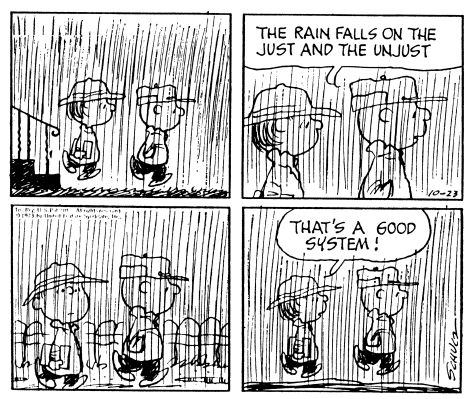
Peanuts rain
Matthew 5:45

the·od·i·cy (thē-ˈä-də-sē ) noun – An explanation of why a perfectly good, almighty, and all-knowing God permits evil

Habakkuk 1:2-3(ESV)
O Lord, how long shall I cry for help,
and you will not hear?
Or cry to you “Violence!”
and you will not save?
Why do you make me see iniquity,
and why do you idly look at wrong?
Destruction and violence are before me;
strife and contention arise.
So the law is paralyzed,
and justice never goes forth.
For the wicked surround the righteous;
so justice goes forth perverted.

In a world full of such beauty and love and happiness, we also find sadness, pain, and disaster. There are tornadoes, hurricanes, earthquakes, plane crashes, school shootings, holocausts, wars, rapes, all manner of diseases, death… The Christian view of God is that He is good. That God is in control. That God cares and loves His creation. If this is true, then why is there so much suffering? This is perhaps one of the biggest if not the biggest stumbling block to many people when it comes to understanding God. And not just understanding God, but a lot of people just reject the notion of an omnipotent and omniscient God because of what’s known as the “problem of evil.”

Why does a good God allow evil?

Ancient skeptic and philosopher, Epicurus, said of God, “Is he willing to prevent evil, but not able? Then he is impotent. Is he able, but not willing? Then he is malevolent. Is he both able and willing? Whence then is evil? Is he neither able nor willing? Then why call him God?”

Are God and evil mutually exclusive? Does the existence of evil negate the existence of God? Some would say that to have both in the same universe would be a contradiction.

First let’s start with definitions. Let’s define “God” and “evil.” Merriam-Webster online defines God as “the Being perfect in power, wisdom, and goodness who is worshiped as creator and ruler of the universe.” They define evil as, “arising from actual or imputed bad character or conduct. The “archaic” form is “causing discomfort or repulsion.” So, for its use in this blog “evil” consists of both natural and man-made trouble.

So God is defined as “perfect in power.” This means He can do absolutely whatever He chooses to do. As the Psalmist said, “He does whatever He pleases.” Being perfect in power He can stop all evil.

“Perfect in wisdom” means that He will never make a mistake and everything He does is absolutely wise. And being perfect in goodness means that all goodness dwells in Him and in Him there is no evil.

So if this all powerful, all wise, all good God exists and sees the evil in the world, why doesn’t He stop it?

Well we must ask ourselves what exactly is it we want stopped. Do we want God to stop all evil? If so and you’ve ever had an evil thought then you would want God to control your thoughts. If you’ve ever uttered an evil word, you would want God to control your speech. If you’ve ever done an evil deed or even made a mistake that caused harm, you would want God to control your actions. Therefore, we are asking for one of two things if we want God to stop all evil: 1. That God take all free will from mankind, or 2. God kill us upon our first evil thought, word, or deed.¹ And we can’t ask that justice be done to others and not to ourselves.

Now let’s break down Epicurus’ argument:

  • Is God willing to prevent evil? Well if He is good we would have to say yes. We also know from the Bible that He is willing to prevent evil. He Himself heals. And He sends people out to heal the sick, warn people of judgement, and free slaves.
  • Is God able? A perfectly powerful God is definitely able to prevent evil. But ability doesn’t mean necessity. A good God may allow things that we deem bad for other purposes. He doesn’t have to stop evil.
  • Whence then is evil? Or from where does evil come? This is an important question to consider when pondering the existence of a good God when evil is so prevalent in the world.

Is evil “bad” just because it causes discomfort and repulsion? If so, the act of a parent correcting a child is “evil.” But of course a parent correcting a child is doing a good thing. But it feels bad. It causes discomfort and no child- nor any adult for that matter – likes correction. And, of course we can say that a parent, or teacher, or friend that corrects is doing it for the other person’s good. Therefore, we would rarely call it evil because we know there is love behind it. So we can logically say there are some things which feel bad that actually aren’t. We can also look at childbirth, growing pangs, the pain we get in our muscles from exercise that facilitates gaining strength: not all pain and discomfort are bad.

But of course there are those things caused by wrongdoing. People with malicious intent doing bad things for a bad purpose. What are we to make of that? And if God can stop them and if it’s in God’s good will to end evil then why doesn’t He stop them? Well as I mentioned earlier, where then would free will be? God can do whatever He pleases, but to stop all evil men from doing evil deeds He would have to stop all evil hearts. As Jeremiah tells us, “The heart is deceitful above all things, and desperately sick; who can understand it?” This would mean at best we would all be “robots” with no will of our own, or at worst destroyed at the first bad thought.

What about “natural evil?” Stopping that wouldn’t inhibit human free will, right? Why doesn’t God stop natural disasters? Well, it would seem that most people “accept” natural evil as “nature being nature.” Not that they like all that happens in nature, per se, but that those things that happen naturally are more acceptable than “moral evil” caused by man. But for the atheist, the discomfort “natural evil” may cause has no good or bad to it. Actually, it should be seen more so as a good thing if it is just nature doing what nature does. It would be just the earth or universe replenishing itself or going through its phases. If plagues happen, it’s just nature. So why seek to cure disease? Also, what about nature would the inquirer want God to stop? Many aspects of nature that can harm us are also things that we need to survive on this planet. Would God need to make water less dangerous to prevent drownings? He would need to make the composition different, but then it would cease to be water. Lightning is another example. Lightning strikes kill many people every year. But, we need lightning. All life requires nitrogen-compounds and “the enormous energy of lightning breaks nitrogen molecules and enables their atoms to combine with oxygen in the air forming nitrogen oxides. These dissolve in rain, forming nitrates, that are carried to the earth.” (http://www.biology-pages.info/N/NitrogenCycle.html) Basically, we need lightning for healthy air and fertile soil.

Well, you might say “that’s all well and good but an all-powerful God could prevent lightning from striking people.” And you would be right. But, once again, that would involve preventing me from being in a certain place at a certain time so that I am not struck by lightning. “Well doesn’t Christianity claim that God does, in fact, intervene sometimes to prevent such occasions?” Yes, whenever God intervenes to prevent what would otherwise have happened, that is called a miracle. As Christian philosopher C.S. Lewis writes, “That God can and does, on occasion, modify the behaviour of matter and produce what we call miracles, is a part of Christian faith; but the very conception of a common, and therefore stable, world, demands that these occasions should be extremely rare.” Have you or someone close to you said after some natural or otherwise unfortunate event, “I was supposed to be there at that moment but ________ happened and I’m alive because of it.”?

Now back to God’s wisdom. When we are children, our parents often tell us that we can’t do something we want to do. We think we are smart enough and mature enough to do whatever it is, but our parents spoil the fun with a “No!” or “Stop!” and sometimes, if we’re lucky enough, we get an explanation of why. Sometimes. Those other times we don’t get the reason because we wouldn’t understand it even if they told us. And we definitely wouldn’t agree with the explanation because we don’t understand it. Our parent’s life experiences and wisdom gained from those experiences have given them a better understanding of the world around us than we have as children. So, their no’s to us may seem cruel at times but it is often for our benefit.

God created the world around us and the universe beyond us. God sees the past, present, and future all at once. God, therefore, is more knowledgeable than our parents (and, of course, us) could ever have dreamed of being. Our knowledge is finite and therefore our wisdom and perception are finite. God is infinite and therefore His wisdom is infinite. So while we can’t always know the reasons of the pain and suffering we experience here on earth, we can know that God does. So, because of our ignorance the words of Job ring true, “Surely I spoke of things I did not understand, things too wonderful for me to know.” Job 42:3


Evil proves God exists. Why do we hate “evil”? Why would someone question why bad things happen? It is because we know that there is a standard of good and of rightness and therefore whatever is “evil” doesn’t seem to meet the standard. We know a line is crooked because we know of straightness. Anything that goes against the “transcendentals” (truth, beauty, and goodness) is evil, bad, or wrong. Since God is defined as perfect in goodness, He is the standard against which one judges evil. If God does not exist, whence then is evil? What standard does anyone have to judge evil? Evil and goodness would only exist as opinions.


If naturalism is true, the best hope we have is that we will return to the nothing from which naturalists say we came. That not only does pain end when we die but so does any amount of pleasure and joy. Nothing created us for no purpose and back to the void of nothingness we will return. All of our pleasures and pain on earth were for naught. No truth, beauty, or goodness awaits in exchange for all the suffering in the world.

However, the Bible tells us there is a reason that pain and suffering are in the world. Man’s sin is so potent that it affects the world. Adam and Eve’s disobedience caused death to come into the world. Before sin, there was no hard work, pain in child labor, shame, disaster, or death. The Bible also promises us that all will be made right again. That God is a God of justice. That one day man will be free from pain and suffering. That one day even nature will experience this freedom. This freedom is not just an absence of pain. Ceasing to exist could do that. No, this freedom from pain will be because of unconquerable and unending joy. This freedom comes to those who place their faith in God. This promise is for those of us that believe He has this gift awaiting us and that it is only available through His only begotten Son, Jesus. God has promised us that the pain on earth has been used to make a way possible to live eternally. The death that Jesus died on the cross was the death that brings us life. What was meant for evil, God is using for good.

“He will wipe away every tear from their eyes, and death shall be no more, neither shall there be mourning, nor crying, nor pain anymore, for the former things have passed away.” And he who was seated on the throne said, “Behold, I am making all things new.” Revelation 21:4-5(ESV)

Footnotes:
¹I present to you that this might be a false dichotomy. And it actually answers the question of “How can evil exist if a good God exists.” The third option is that God uses people to change things. He sometimes uses people to show the world His love and goodness. He uses people to spread His good news, administer justice and benevolence. Anytime God’s people do God’s will, we see God in action.

Derrick Stokes
Theologetics.org