When a Symbol Becomes a Snare: The Bronze Serpent and the Danger of Idolatry

In Numbers 21, we read one of the more surprising rescue stories of Israel. The people rebelled, serpents bit them, many died, and Moses prayed for the nation. Then the LORD said:

“Make a fiery serpent, and set it on a pole; and everyone who is bitten, when he sees it, shall live.” (Numbers 21:8)

So Moses made a bronze snake, lifted it high, and those who looked endured. That bronze image was, in its moment, a divinely-given means of deliverance. It was not magical in itself, but God created it as a sign: repent, look, live.
Later, however, we read in 2 Kings 18:4 that King Hezekiah destroyed that very bronze serpent — called Nehushtan — because the people had begun to burn incense to it. What was once a tool became an idol.

The bronze serpent was not a fetish. It was not meant to become the object of worship. It was a “look and live” sign. The serpent foreshadowed later realities (as Jesus himself referenced in John 3:14–15) — the lifted-up Christ, who brings healing, life, and redemption.

The key is: God ordains means, for his purposes, in his time. A means is good so long as it points away from itself and points to him.

But the bronze serpent became a problem. 2 Kings 18:4 states:

“…for up to that time, the Israelites had been burning incense to it. It was called Nehushtan.”

What changed? The people stopped seeing the object as the means. They began venerating the object. They burned incense. They worshipped the serpent. The means became the end. The sign became the substance. The action became the object of trust.

Thus, we see a pattern:

1. A god-ordained symbol becomes a comfortable habit.

2. A god-ordained tradition becomes a barrier to biblical truth.

3. A god-ordained means becomes the substitute for the true end.

If we’re not cautious, the very things God uses to bless our faith become traps in our devotion.

What does this look like in our context today?

Perhaps a worship style, a ministry program, a church tradition — originally given to serve — becomes the thing we cling to, rather than Christ.

Perhaps a past experience of God becomes the standard prize rather than the person of God.

Perhaps a helpful symbol, like a cross on a necklace, becomes the locus of our trust.

When the object of our faith becomes anything but the living God, we drift into idolatry. And idolatry is not just bowing to carved images; it is anything that takes God’s place in our hearts (see Romans 1). To serve the created rather than the Creator is to become idolaters (Romans 1:25).

Hezekiah’s act of breaking the bronze serpent is a striking image. It’s not destruction for destruction’s sake: it is obedience to the Lord’s re-ordering of worship. The object itself had done its job — it had served its day — and now it hindered the true worship of the living God.

We, too, must ask: Are there “bronze serpents” in our lives? Things once used by God that now stand between us and God. Things we trust in, cling to, bow down to — though they were only meant to lead us to Christ.

Therefore, be thankful for the means God has given. Use them. But never worship them. When they become a wall rather than a window to God, they must go.

The gospel is always about Christ, not our methods. Always about faith, not form. Always about the living God, not our comforts.

The Lifted Serpent and the Lifted Savior

Jesus said of this ancient event:

“Just as Moses lifted up the serpent in the wilderness, so must the Son of Man be lifted up…” (John 3:14)

The bronze serpent pointed to Christ on the cross. The serpent on the pole drew the dying, the wounded, the bitten — and when they looked, they lived. Christ on the cross draws sinners, wounded by sin, and grants eternal life by his work. The serpent was never the object of worship — Christ is.

Let us, therefore, live by faith in Christ, not in our symbols. Let us worship God in spirit and truth (John 4:24). Let us tear down our idols — even those born of good intentions — that none may stand between us and the one true God.

Conclusion

The story of Nehushtan is a sober warning and a hopeful message. A warning: that the means can become the idol; a hopeful message: that Christ is the true object, the true end, the living hope. May our hearts hold fast to him — not the bronze snakes of our past, but the Living God who grants life by faith.

Derrick Stokes for Theologetics.org
The Doctrine of Adoption

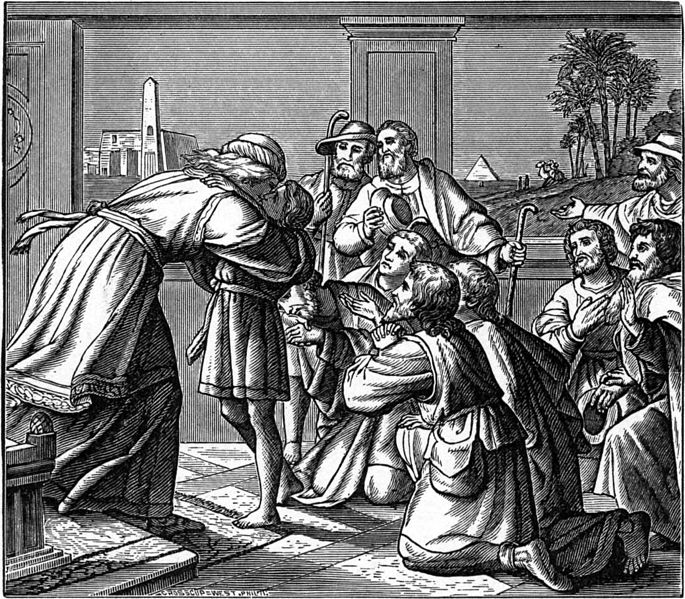
Joseph Kissing His Brother Benjamin by Charles Foster, 1897

2 Corinthians 6:18 “I will be a Father to you, and you shall be my son’s and daughters, says the LORD Almighty.”

In the book of Genesis, Jacob (who’s name was changed to Israel), became the father of 12 sons and a daughter. His 12 sons became the 12 tribes of Israel. They are listed here in order of birth:

  1. Reuben
  2. Simeon
  3. Levi
  4. Judah
  5. Dan
  6. Naphtali
  7. Gad
  8. Asher
  9. Issachar
  10. Zebulun
  11. Josheph
  12. Benjamin

The familiar story of Joseph, Israel’s favorite and unique child (Gen 37:3), tells how he became exhaulted over his brothers and elevated to the highest position in the land under the king. Joseph is an early type and foreshadowing of Christ.

In chapter 41 Joseph has two sons Ephraim and Mennaseh by his Egyptian wife. After Joseph’s family joined him in Egypt, his father Israel, blessed Ephraim and Mannaseh. But he did something peculiar. He didn’t just bless them as his grandchildren. His blessing was bestowed on them as though they were his own sons.

Genesis 48:5-6 And now your two sons, Ephraim and Manasseh, who were born to you in the land of Egypt before I came to you in Egypt, are mine; as Reuben and Simeon, they shall be mine. Your offspring whom you beget after them shall be yours; they will be called by the name of their brothers in their inheritance.

Notice how Israel spoke Ephraim and Manasseh compared to his first two sons. They will be just as important as the first born sons of Israel. Not only just as important, but Israel claims them as his own children.
In theology we have what is known as the doctrine of adoption. Jesus Christ being the firstborn of God (Colossians 1:15), those who are adopted by God through faith become sons of God or “co-heirs with Christ”.

Romans 8:14-17 “For as many as are led by the Spirit of God, these are sons of God. For you did not receive the spirit of bondage again to fear, but you received the Spirit of adoption by whom we cry out, “Abba, Father.”  The Spirit Himself bears witness with our spirit that we are children of God, and if children, then heirs—heirs of God and joint heirs with Christ, if indeed we suffer with Him, that we may also be glorified together.”

Like Joseph’s children born of foreign land, we Gentiles were also born as foreigners of Israel. But, through Christ we have access to the Father, like Ephraim and Manasseh had through Joseph. As we read in Ephesians 5:1, “He predestined us to adoption as sons through Jesus Christ to Himself, according to the kind intention of His will.”

John 1:12 says “But as many as received Him, to them He gave the right to become children of Godeven to those who believe in His name.”

Also read: 1 Chronicles 28:6, Hosea 2:23 (Romans 9:24-26), Romans 9:8, Galatians 3:7, 26, 29; Galatians 4:4-5,  Ephesians 3:26

Derrick Stokes
Theologetics.org

The Shema and The Trinity

moses_speaks_to_israel
MOSES SPEAKS TO ISRAEL, by Henri Felix Emmanuel Phillippoteaux

“The Shema is the central prayer in the Jewish prayer book. It is generally one of the first prayers a Jewish child learns. The Shema defines what it means to be Jewish as it has since the days of Moses:

Shema Yisrael Adonai Eloheinu Adonai Echad—“Hear, O Israel: The LORD our God, the LORD is one” (Deuteronomy 6:4).”

http://www.jewishvoice.org/media/publications/articles/yeshua-and-the-shema.html?referrer=http://www.google.com.af/

If the the Shema states that God is one, doesn’t that contradict the Christian doctrine of the Trinity?

If the LORD is One, then how can He be also Three? The word “echad” (the ch is more of a throaty h sound) in the above verse is the Hebrew word for one. But, if we believe God is a Trinity how do we reconcile this apparent contradiction?

Well, in Genesis 2:24 the same word “echad” is used to describe how a husband and wife will become one flesh.

In Genesis 11:6, the tower of Babel narrative describes the people as being one (echad).

Ezra 2:64 the whole assembly is gathered together (echad). But the people in the assembly numbered 42,360. In these verses, echad represents a unified oneness, not a numerical oneness.

Now, I can’t say that echad always represents a unified oneness. Sometimes it can represent a numerical oneness (Ex. Numbers 13:2, Deut.17:6) . So how do we know the difference?

As usual, the answer lies in the context. The word for God in the Shema is plural אֱלֹהִים (‘Elohiym). Just like Genesis 2:24, chapter 11 verse 6, Ezra 2:64, and others not listed here, echad means a compound unity.

You will see the word Eloheinu above and perhaps think that’s different than the plural Elohiym. The only difference is Eloheinu means “Our God” but the root word is still the plural word Elohiym.

Therefore, we see that even before the Trinity was understood as we understand it today, the Hebrews of the Old Testament understood there was a vastness and complexity to the Godhead. The very first word used for God in the Bible (Genesis 1:1) is the plural word Elohiym.

So there is no contradiction. God does not change (Malachi 3:6).

Psalm 102:25-27
“In the beginning You laid the foundations of the earth, and the heavens are the work of Your hands.They will perish, but You remain; they will all wear out like a garment. Like clothing You will change them and they will be discarded. But You remain the same, and Your years will never end.”

Derrick Stokes
Theologetics.org