Relationship or Religion

When people speak of Christianity, it is often described exclusively as either a religion or a relationship. Those who argue that it’s purely a relationship oftentimes see religion as a negative thing, at least for Christianity. Religion is typically seen as a stiff set of rules held by stiff people wearing their stiff clothes holding their stiff noses in the air as they judge the sinners around them. The Christianity-is-a-relationship crowd tends to place emphasis on love, acceptance, and freedom. On the other hand, the ones who see it as a religion seem to have a more encompassing view of what Christianity is, in my opinion. Yes, it is love and acceptance and freedom. But it also includes structure, rules, and some of the less feel-good aspects like “the wrath of God.”

However, those in the relationship crowd aren’t very different from those in the religion crowd when it all boils down to it. Think about what a relationship is, whether it be between spouses, friends, family, or employees/employers. There are rules, whether spoken or unspoken, written or unwritten, that govern whether the relationship is going to be healthy or not. A healthy relationship has boundaries. One or all parties involved understand that there are certain things that they shouldn’t do if they want to continue in harmony with the other participant(s). A husband knows that certain things will make his wife legitimately unhappy and that other things will bring her happiness and security. Some things may have more bearing on the trajectory of the marriage than others. A cheating spouse is more at risk of causing the marriage to end than a spouse who forgets to take out the trash. Or, in an employee/employer relationship, stealing time is more detrimental than stealing a pen or paperclip. Either way, it’s understood that no matter the relationship, there is typically a strict set of do’s and don’ts if you want the relationship to last. I feel that perhaps, more often than not, those who adhere to a strict mindset of Christianity being a relationship and not a religion want to do away with the religious aspect because they don’t think it’s should be about rules. To this, I agree. It shouldn’t be about rules. It should be about the object that we want to have a relationship with. I didn’t marry my wife for it to be about rules, but I did get married knowing that there are rules that I would have to abide by if I want the marriage to work. Some rules are universal, like don’t cheat. Some rules are more specific to the relationship because of the individuals involved. My wife doesn’t like her steak well done, so I know not to let it cook on the grill for longer than she would like. If I messed up the steak once or twice, she’ll forgive me, but if I do it every time, she may feel as if I don’t care or am doing it out of spite. 

The problem with some in the religious crowd is that it has become about rules. The relationship has been completely dismissed for a checklist. Usually, it is a checklist of negatives. Don’t smoke, don’t drink, don’t wear that, don’t say that, don’t go there, don’t watch that. It can easily become (or at least be seen as) a joyless list of impossible commands to appease a joyless and angry God. Many people would rather do without such stringency.

So people do away with the “religion” and its rules. Relationship feels better. It comforts. It brings peace. It brings freedom. It lifts up and encourages. Some say they’re not religious but are “spiritual.” There are various reasons one may claim to be spiritual, but one of the reasons is often a rejection of the rigidity of religion. Some even go further and reject it all together. (Sadly, some people who reject religion aren’t very good at relationships either. They want the security that either may bring but they also want the freedom that makes neither an option. You can’t live as a single person and expect a happy marriage. You can’t be employed but live as though you have no job.)

I feel that what’s missing on both sides is a true understanding of what Christianity is supposed to be. It’s both a religion and a relationship. Merriam-Webster defines religion as “a personal set or institutionalized system of religious attitudes, beliefs, and practices.” Britannica sites religion as: human beings’ relation to that which they regard as holy, sacred, absolute, spiritual, divine, or worthy of special reverence. Both definitions, along with any other I could find, describe what Christianity is. However, that’s like looking at a book and describing it by giving the definition of a book.

Christianity is so much more.

In the New Testament of the Bible, Jesus is often seen rebuking the religious leaders of his day (this fact is frequently used as proof that our faith isn’t a religion). But like the religious leaders in Jesus’ time and those in modern times, the religion is weaponized. The Pharisees and Saducees used the Jewish religion and its rules hypocritically. They misunderstood what the law was given for. One such example was when Jesus healed a blind man on the Sabbath. According to the “rules,” no work was supposed to be done on the Sabbath. This law was (and still is) a good law because it requires rest. Any hard worker understands that sometimes you have to be made to take a breather. Don’t work yourself so that you don’t get time to enjoy yourself and your loved ones. Take a day to enjoy the fruits of your labor. Take this day as a day to gather and worship God. Instead, the religious leaders made it another burden on the people. When Jesus healed the blind man on the Sabbath, he was chastised. John 9 tells us, 

They brought to the Pharisees the man who had been blind. Now on the day which Jesus had made the mud and opened the man’s eyes was the Sabbath…Some of the Pharisees said ‘This man is not from God, for he does not keep the the Sabbath.’” (verses 13-16 NIV).

While the Pharisees knew the letter of the law, Jesus understood the spirit of the law. The rule concerning the Sabbath kept someone from lifting burdens on that day. Jesus freed a man from his burden that day.

When God gives rules, they are to help us. To keep us from trouble. Sometimes, the trouble is unknown to us. Rules aside, the Bible is full of relational statements. God desires all who he created in his image (that’s all humans) to be his sons and daughters. But as I mentioned earlier, to have a healthy relationship with anyone, there are expressed boundaries set by one or more parties. God himself has expressed what his boundaries are. He has said that there are things we ought to do and things we ought not do. The goal isn’t in the oughts and ought nots. The goal is  the object of our affection. That object is God. The all-knowing lover of our souls knows what benefits us and what hurts us even when we don’t. Just because something feels good doesn’t mean it’s beneficial in the long run, just like one may use maladaptive coping mechanisms to deal with stress, but in the end, it leads to more hurt.

James 1:15 ESV
Then desire when it has conceived gives birth to sin, and sin when it is fully grown brings forth death.

So I’ll end this by saying that yes, the Christian faith is a religion, technically. The goal, however, is relationship. It is what God desires to have with us. It is the reason Jesus came and died: so that we may be reconciled into right relationship with him when we have strayed. But for us to stray means that there was a  breach in the relationship. We sometimes walk away by doing what God has expressed displeases him. In the same way, many of us have had failed relationships because we or the other party did something that had negative repercussions on the bond. If we continue, the bond can be severed forever. Likewise, if we continue in ways that displease God, we are severing our bond. One day, it’ll be too late to reconcile.

Read also: James 1:27, Luke 15

Derrick Stokes

Why Doesn’t God Forgive Sin Without a Sacrifice?

If God can do anything He wants, why doesn’t he just forgive sin? He’s all-powerful. He’s the epitome of love. So, why did He need a sacrifice for sin? Why doesn’t He just say to everyone, “Poof your sins are forgiven!”

The Return of the Prodigal by Rembrandt

In the beginning, we are told that God gave mankind one rule: don’t eat the forbidden fruit. We only had that one rule. We still disobeyed. God drove man from His earthy temple, Eden, but not before telling them a promise. We’ll get back to that promise later.

Why would God need to send them away, though? Couldn’t He just have said, “I forgive you. Don’t do it again. Stay and enjoy paradise”? Furthermore, later in Scripture, we are told that God requires us to forgive someone who sins against us, and if we don’t, then He won’t forgive our sins. But wait. Why do we have to be the first to forgive? Is that even fair?

Well, I believe that to understand this, we must first understand who God is and who we are in relation to God.

God, who is the most perfect being, created man. Man is not a perfect being. As I stated earlier, the earliest man couldn’t even keep one rule. God is all-powerful (omnipotent), all-knowing (omniscient), and the ultimate goodness (omnibenevolent). Man is none of these things. We can only know so much, do so much, and have a limit on how good we can be. God, because of His omnibenevolence, cannot sin. Since we do not have that attribute, we do sin.

To illustrate my point, let’s say I kicked a small rock down the road. It’s not a being that can not feel or think because it’s incapable of life. I’ve done no wrong. Now, let’s say I’ve kicked a bug that wasn’t bothering me. I’ve likely caused it harm or even killed it, and this action probably speaks negatively about my character. But it basically stops there. Now let’s say I continue down the road and I see a dog and decide it’s a good idea to kick it. Well, if it doesn’t bite me, I could actually be charged with animal cruelty in many places and if it’s someone’s pet, the dog has more intrinsic value bestowed on it, and I could get in trouble with its family also. There would be even more trouble for me if I chose to kick one of the dog’s human owners.

Basically, as I moved up the “hierarchy” of existing things, I committed more of a trespass against each thing. Even if I was never caught, most people would probably agree that some cosmic or divine justice would (or at least should) await me for my moral failing. The higher the being, the more I would be indebted to some sort of restitution even if it’s just an apology.

This brings me to my point. Our trespasses (sins) against a Being who exists in infinite goodness increases because of who He is. The increase is so much that an infinite punishment is the only justified payback.

When man sins against man, the debt is much less than when man sins against God.

Jesus told a story about a master who called his servant to him to settle an outstanding debt he owed the master. The servant begged and pleaded that the master would be merciful, and the master was. Later, the servant sees another servant who owed him much less than the first servant owed his master. The second servant begged for mercy, to which the first refused to listen and had his family thrown into prison until he received his money. The king heard about the incident. “You wicked servant! I forgave you all that debt because you pleaded with me. And should you not have had mercy on your fellow servant, as I had mercy on you?” He then had the servant thrown into prison until he could repay the debt. (Read Matthew 18:23-34).

Immediately before Jesus told this story, his apostle Peter asks how often he should forgive his brother if his brother sins against him. “As many as seven times?” Peter inquires to which Jesus answers, “not seven times, but seventy-seven times.” Some translations say seventy times seven. By following up Peter’s question with the above story, Jesus illustrated that sins against the Master are exponentially greater than sins against each other.

When you read the parable, take note of the amount that the servant owed his master: 10,000 talents. A “talent” was twenty years wages. Twenty years!! One talent=20 years wages. This man owed 10,000 talents to his master. That’s 200,000 years of wages he owed. There was no earthly way that this man could have repaid that debt. The amount his fellow servant owed him was worth only a few hundred days of work.

You may ask, “Since Jesus told the story, and He said that the master was just going to forgive the servant, why can’t God just forgive us?” The point of the parable was to show how our sins against each other pale in comparison to our sins against God. But it does remind us that God is merciful.

I’ve mentioned that God is all-powerful, all-knowing, infinitely good, and merciful. I must add that His goodness goes hand in hand with another attribute, His justice. As a good and just judge, he must punish wrongdoing. Otherwise, he is neither good nor just. Take a moment and think about some of the bad things you’ve done in life knowing what the punishment could have been, and you still proceeded to do the evil deed. How brazen we can be! Now imagine the only “punishment” awaiting our evil deeds was God saying, “Ahh, it’s all good! Just don’t do it again!” You better believe we’re gonna do it again! So, since it’s not “all good,” He punishes because He is all good. And since He is all-good, He still makes a way for us. How? He paid our debt, nailing it to the cross of Christ. (Colossians 2:14)

In conclusion, since God is the highest being (The Most High), any sin against Him is of the highest offense. Any sin man commits against his fellow man is not. Therefore, God does not have to forgive us just because He is good. Instead, because He is good (and just), He must punish sin. However, the good news is that Jesus, the promise God told Adam and Eve, took our penalty for sin on His own back by dying on the cross. The ultimate goodness took on the ultimate punishment. Those who repent and believe this are forgiven and free. And if you are forgiven, you must forgive others.

Derrick Stokes

Theologetics.org

The Virgin Birth

jesus-birth-james-schultz
Jesus’ Birth by James Schultz, 2017

The virgin birth of Jesus is one the main tenets of the Christian faith. This miraculous event is recorded in Scripture. Had Jesus not been born of the virgin Mary, He wouldn’t have been the proper sacrifice for our sins. He would have been born into sin and therefore would have sinned. According to the Old Testament, the sacrifice for sin had to be spotless and without blemish. Regarding Jesus, this doesn’t mean spotless physically. This means that He was without sin. His blood did not carry the sin trait that was borne to the rest of us from Adam.

What about His mother? Wasn’t she human born into sin? The Catholic doctrine of the Immaculate Conception teaches that Mary was born without sin in order for her to  conceive a sinless Christ. However, there is no biblical proof of the Immaculate Conception (which begs the question; wouldn’t the same logic require Mary’s mother to have been born without sin to conceive a sinless Mary, and her mother before her, and so on and so forth?). Mary needed saving from her sins like we all do. It was believed in the past that the baby in the womb shared his mother’s blood. What we know today, however, is that the baby when in the womb makes his own blood. His blood is unique to himself. That’s why Jesus’ blood, and Jesus’ blood only, has the power to wash away sins.  “The fetal blood and maternal blood do not mix. In fact, if this were to be the case, there would be such immunological protest from the mother that she would soon make enough antibodies to the baby’s blood to destroy the pregnancy.” (https://www.babble.com/pregnancy/anatomy-fetus-placenta/)

Jesus was unique in that His father was God. Although the Bible calls the nation of Israel the child of God in the Old Testament (Exodus 4:22, Deuteronomy. 14:1) and those that place their faith in Jesus are His children (Romans 8:16-17) under the New Covenant, only Jesus is called the “only begotten”. Jesus is God’s only son in the same way God called Isaac Abraham’s only son (Genesis 22:2) even though Abraham had another son (Ishmael) prior to Isaac. The Greek word for “only begotten” is monogenēs (μονογενής) which literally means “one of a kind” or “the only of its kind.” In the ancient near East, a person’s lineage was based on who their father was, not their mother. Jesus was, therefore, of His father and not of His mother. This also has scientific bearing today. As this article from Discover magazine puts it “You may have inherited your mother’s eyes, but, genetically speaking, you use more DNA passed down from your father.” If Jesus was born of Joseph and Mary, He could not have been the only begotten son.

One of the main arguments against the virgin birth is that the word for virgin in the Book of Isaiah means “young girl” or “maiden”. Thus the prophecy only means that the Messiah would be born to a young girl.

This argument, however, fails to take a few facts into consideration. In Isaiah chapter 7, verse 14, the prophet foretells of the future Messiah being born of a virgin. The Hebrew word for virgin here is עַלְמָה or “almah”. Almah literally means “a virgin, maiden, a young woman of marrying age.” People dismiss that almah can mean virgin and say that it just means a young woman. And that Mary was just a young “betrothed” woman, not a virgin when she conceived Jesus. However, nowhere in the Hebrew scriptures does “almah” denote a young woman who is not a virgin.

An important part of understanding scripture is to understand what other scriptures say concerning the same topic. Let’s just say that we can’t tell whether Isaiah 7:14 is speaking of a virgin or just a young woman. Well we look to see how the authors of the New Testament would have read it. Matthew 1:22 is proof that the Jews of the time knew Isaiah 7:14 was speaking of a literal virgin and Matthew shows that Jesus is the fulfillment of this prophecy. When the angel Gabriel announced to Mary that she would conceive a child, she said “How can this be, since I am a virgin?” If she were just a young and married woman, it would not have come as such a surprise to her. Gabriel also would not have had to say that the child would be conceived of the Holy Spirit. No other place in scripture describes a birth in this fashion. The prophet Samuel was a “miracle child” but scriptures plainly tells us that his parents “knew” each other before he was born (1 Samuel 1:19). Samson was a “miracle child” but He was not conceived of the Holy Spirit or born of a virgin. Isaac was a miracle born to Abraham and Sarah, not because Sarah was a virgin, but because she was too old too conceive.

The whole purpose for the virgin birth, the whole purpose for the incarnation, was the cross. Actually, it was love that led to the cross. The cross is of much importance because of Who was hung on the cross. It was God who became a man. Born of a virgin. Laid aside heavenly pleasure for the likes of earthly pain. Only God could do this. Only He could be the sacrifice for our sins.

As C.S Lewis says, “Now if we had not fallen, that would all be plain sailing. But unfortunately we now need God’s help in order to do something which God, in His own nature, never does at all – to surrender, to suffer, to submit, to die. Nothing in God’s nature corresponds to this process at all. So that the one road for which we now need God’s leadership most of all is a road God, in His own nature, has never walked. God can share only what He has: this thing, in His own nature, He has not.
But supposing God became a man – suppose our human nature which can suffer and die was amalgamated with God’s nature in one person – then that person could help us. He could surrender His will, and suffer and die, because He was man; and He could do it perfectly because He was God. You and I can go through this process only if God does it in us; but God can do it only if He becomes man. Our attempts at this dying will succeed only if we men share in God’s dying, just as our thinking can succeed only because it is a drop out of the ocean of His intelligence: but we cannot share God’s dying unless God dies; and he cannot die except by being a man. That is the sense in which He pays our debt, and suffers for us what He Himself need not suffer at all.”

Further reading: Hebrews 7:26, Romans 5:12,17,19

Derrick Stokes
Theologetics.org

The 2nd Hidden “Verse” about Jesus in Genesis

Descent-from-the-Cross
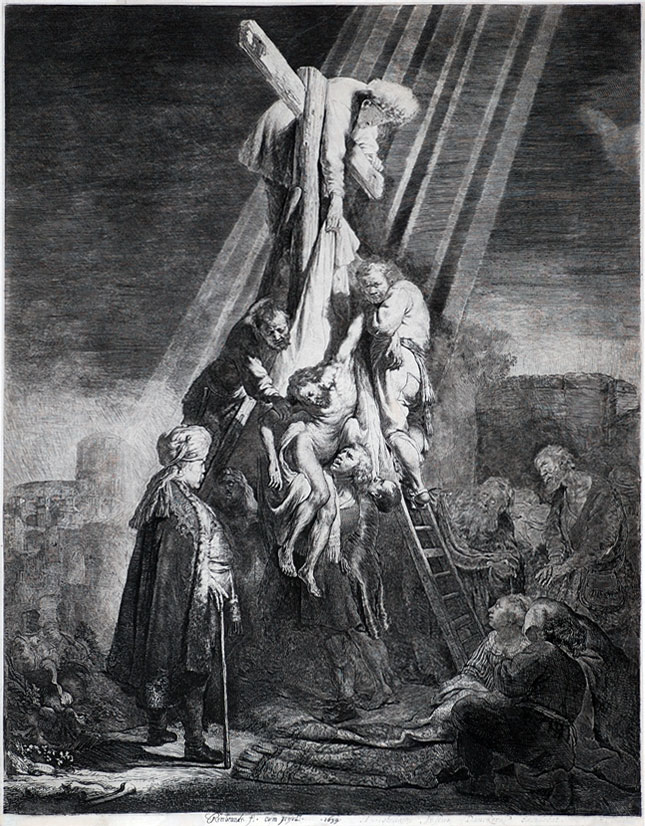
Rembrandt, The Descent from the Cross: the Second Plate, Date
1633


It is incredible to think, that the God who created the entire universe by speaking it into being, would love us and want to know each one of us on a personal level. And that this same God inspired various imperfect people from all walks of life to write about his love for us in a collection of ancient manuscripts we call the Bible. But it’s not only that his love was written about and revealed to us but when you dig into the original languages the Bible was written in, you can see the story of Jesus thousands of years before he was even born hidden in unique ways.

It is more apparent to me today than it has ever been that God is incredibly multi-faceted, so much more than 3-dimensionally and I feel like the more I learn about the Bible the more this can be clearly seen. One example of this is a previous blog we wrote that talks about the hidden “verse” about Jesus in Genesis 5 which outlines the various definitions of the names of the line of Adam to Noah which reads much like a Messianic prophecy. This blog is similar in that it outlines various definitions of the names of the twelve sons of Jacob which has another amazing resemblance to the story of Jesus. I was first made aware of this from something someone else posted on social media.

Lets begin…

Genesis 29:31-35, 30:1-24, and 35:16-18 describes the 12 sons of Jacob who would become the fathers of the 12 tribes of Israel. The following are a list of the 12 sons in order of birth with meanings of each name listed next to it;

1 Reuben – Behold A Son, Son Of Vision, Son Who’s Seen
2 Simeon – Hearing, He Who Hears, Man Of Hearing, Hearing With Acceptance
3 Levi – Joined, Adhesion
4 Judah – Let Him (God) Be Praised, Praised
5 Dan – Judge, Judging
6 Naphtali – My Wrestling
7 Gad – Good Fortune, Harrowing Fortune
8 Asher – Happy, (happiness, to be right in the eyes of someone, to obtain this person’s approval)
9 Issachar – Man Of Hire, He Is Wages, There Is Recompense
10 Zebulun – Glorious Dwelling Place, a rather reserved Dwelling, Wished-For Habitation
11 Joseph – Increaser, Repeater or Doubler, May He (Yahweh) Add, He Shall Add, He Adds, Increases, May God Add
12 Benjamin – Son (building block) Of The Right Hand (of God)

Each name has multiple meanings and even different roots. Taking into consideration that some of the names clearly describe God and others describe man, one translation of each of the twelve names, one name after the other, reads in this way:

“Behold a son who hears with acceptance, joined to (us), let Him be praised. A judge of my wrestling bringing good fortune to obtain His approval. He is wages (for) a glorious and reserved dwelling place. He shall add (us) son(s) of his right hand.”

Now, Hebrew to English is a little rough to begin with but the main idea is pretty clearly seen even without the added pronouns and conjunctions to aid in connecting the words. This isn’t to say these are the only meanings of the names, some may not even be the primary meanings but it’s amazing that God had Jacob give his children names that could be translated in a way that shows the story of Jesus coming to offer salvation to the world!

http://www.abarim-publications.com/Meaning/Reuben.html#.WYqGk4okqRs
http://www.abarim-publications.com/Meaning/Simeon.html#.WYqGuookqRs
http://www.abarim-publications.com/Meaning/Levi.html#.WYqG14okqRs
http://www.abarim-publications.com/Meaning/Judah.html#.WYqG9IokqRs
http://www.abarim-publications.com/Meaning/Dan.html#.WYqHDookqRs
http://www.abarim-publications.com/Meaning/Naphtali.html#.WYqHKYokqRs
http://www.abarim-publications.com/Meaning/Gad.html#.WYqHSookqRs
http://www.abarim-publications.com/Meaning/Asher.html#.WYqHYIokqRs
http://www.abarim-publications.com/Meaning/Issachar.html#.WYqHf4okqRs
http://www.abarim-publications.com/Meaning/Zebulun.html#.WYqHnookqRs
http://www.abarim-publications.com/Meaning/Joseph.html#.WYqH3ookqRs
http://www.abarim-publications.com/Meaning/Benjamin.html#.WYqH9ookqRs

Clark Campbell
Theologetics.org

Is Theology and Apologetics Really That Important?

marshill
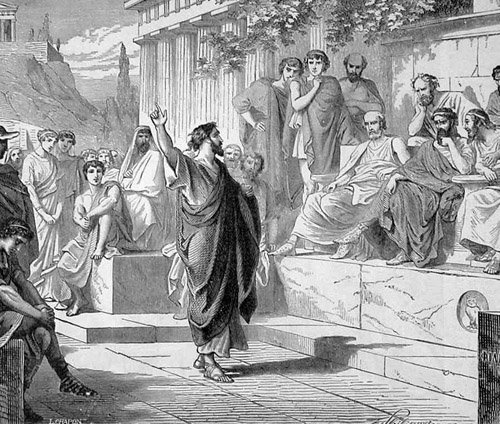
Saint Paul Preaching on Mars Hill (19th century). T. Shilippoteaux. Engraving. © The Provincial Museum of Alberta. PMA:J99.1968.

“Can’t we just read the Bible and worship God without getting all technical?”

Theology is the study of God and is very important. It helps us to understand the God to whom we are worshiping. Proper worship is based on an accurate understanding of who God is. Anytime anyone says anything about God, what is said is something doctrinal. Theology shapes our image of God and if a person’s theology is false then his or her image of God will also be false, which would ultimately lead to idolatry.

In math, the proper answer will proceed from a proper path.

1 + 2 + 3 + 4 = 10

In the same way a proper understanding of who God is, what He would do, and what He wouldn’t do; will inform our doxology (praise) and better guide our prayers.

“Are all these big words and facts really that important?”

For salvation? No. Salvation is not found in head knowledge. However, knowing who God is will help us appreciate Him more, understand the Bible better, and also help us discern false teaching.

Often times we have conversations with family, friends, co-workers, church members, and strangers about God or the Bible. At this point you have just assumed the position of theologian. Apologetics, is the term for defending biblical and theological truths. When these discussions become debates or if you’re just defending you position, you have become an apologist. The more “tools” you have in your mental “toolbox” the better equipped you are to make a defense.

“What about witnessing, isn’t it true that arguing will often just hurt your witness?”

Actually no. If a Christian is just trying to win an argument then he or she will probably do more harm than good but if we allow the Holy Spirit to use the knowledge we have to change a non-believer’s false beliefs about the Bible, Christianity, and God, ultimately this head knowledge can make a huge difference in that person’s heart.

With that said, as Christians, we need to make sure the reasoning we use is sound and that we don’t jump on any “bandwagons” when it comes to modern scientific discoveries. Any scientific argument we use to show that the Bible is accurate could one day be shown to be different or even false, and what the Bible was actually saying may be quite different than what we originally thought but the mistake is not apologetics itself, it would be putting too much trust in man’s knowledge and not enough in the Bible.

An example of this is that through false assumptions and faulty dating methods, many modern scientists believe human life has evolved from smaller and less complex lifeforms over millions of years. While it is quite clear in the Bible that this is not the case and it can even be logically and scientifically shown to be false, there are many Christians who have tried to make the argument that God used evolution to create life. By “jumping on that bandwagon” and taking that stance, it actually weakens the validity of God’s Word because God clearly said in Genesis (written as a historical narrative) that he created everything in the universe in 6 literal days. So when a Christian’s argument becomes making the literal in the Bible something figurative, the Bible becomes a fairy tale instead of something real and that is very sad and dangerous.

I would be remiss if I did not include several disclaimers:

  1. Knowledge of God does not equal a relationship with God. Reading a famous person’s autobiography does not mean you had any kind of relationship with them.
  2. Rebutting objections does not equal evangelism. The goal should be to move someone towards the Gospel.
  3. Head knowledge without the knowledge and guidance of the Holy Spirit can lead to haughtiness and pride. You’re not required to attend each argument you’re invited to. Sometimes the Spirit will move you to be quiet even though you’re knowledgeable on the subject. Sometimes the humble unlearned person will gain spiritual insight and uncanny knowledge when they haven’t been taught by any human. Remember “God apposes the proud but gives grace to the humble.” (James 4:6)
  4. If you read this and want to know more about Jesus, please send us an email at Theologetics3.15@gmail.com we would love to talk with you!