Relationship or Religion

When people speak of Christianity, it is often described exclusively as either a religion or a relationship. Those who argue that it’s purely a relationship oftentimes see religion as a negative thing, at least for Christianity. Religion is typically seen as a stiff set of rules held by stiff people wearing their stiff clothes holding their stiff noses in the air as they judge the sinners around them. The Christianity-is-a-relationship crowd tends to place emphasis on love, acceptance, and freedom. On the other hand, the ones who see it as a religion seem to have a more encompassing view of what Christianity is, in my opinion. Yes, it is love and acceptance and freedom. But it also includes structure, rules, and some of the less feel-good aspects like “the wrath of God.”

However, those in the relationship crowd aren’t very different from those in the religion crowd when it all boils down to it. Think about what a relationship is, whether it be between spouses, friends, family, or employees/employers. There are rules, whether spoken or unspoken, written or unwritten, that govern whether the relationship is going to be healthy or not. A healthy relationship has boundaries. One or all parties involved understand that there are certain things that they shouldn’t do if they want to continue in harmony with the other participant(s). A husband knows that certain things will make his wife legitimately unhappy and that other things will bring her happiness and security. Some things may have more bearing on the trajectory of the marriage than others. A cheating spouse is more at risk of causing the marriage to end than a spouse who forgets to take out the trash. Or, in an employee/employer relationship, stealing time is more detrimental than stealing a pen or paperclip. Either way, it’s understood that no matter the relationship, there is typically a strict set of do’s and don’ts if you want the relationship to last. I feel that perhaps, more often than not, those who adhere to a strict mindset of Christianity being a relationship and not a religion want to do away with the religious aspect because they don’t think it’s should be about rules. To this, I agree. It shouldn’t be about rules. It should be about the object that we want to have a relationship with. I didn’t marry my wife for it to be about rules, but I did get married knowing that there are rules that I would have to abide by if I want the marriage to work. Some rules are universal, like don’t cheat. Some rules are more specific to the relationship because of the individuals involved. My wife doesn’t like her steak well done, so I know not to let it cook on the grill for longer than she would like. If I messed up the steak once or twice, she’ll forgive me, but if I do it every time, she may feel as if I don’t care or am doing it out of spite. 

The problem with some in the religious crowd is that it has become about rules. The relationship has been completely dismissed for a checklist. Usually, it is a checklist of negatives. Don’t smoke, don’t drink, don’t wear that, don’t say that, don’t go there, don’t watch that. It can easily become (or at least be seen as) a joyless list of impossible commands to appease a joyless and angry God. Many people would rather do without such stringency.

So people do away with the “religion” and its rules. Relationship feels better. It comforts. It brings peace. It brings freedom. It lifts up and encourages. Some say they’re not religious but are “spiritual.” There are various reasons one may claim to be spiritual, but one of the reasons is often a rejection of the rigidity of religion. Some even go further and reject it all together. (Sadly, some people who reject religion aren’t very good at relationships either. They want the security that either may bring but they also want the freedom that makes neither an option. You can’t live as a single person and expect a happy marriage. You can’t be employed but live as though you have no job.)

I feel that what’s missing on both sides is a true understanding of what Christianity is supposed to be. It’s both a religion and a relationship. Merriam-Webster defines religion as “a personal set or institutionalized system of religious attitudes, beliefs, and practices.” Britannica sites religion as: human beings’ relation to that which they regard as holy, sacred, absolute, spiritual, divine, or worthy of special reverence. Both definitions, along with any other I could find, describe what Christianity is. However, that’s like looking at a book and describing it by giving the definition of a book.

Christianity is so much more.

In the New Testament of the Bible, Jesus is often seen rebuking the religious leaders of his day (this fact is frequently used as proof that our faith isn’t a religion). But like the religious leaders in Jesus’ time and those in modern times, the religion is weaponized. The Pharisees and Saducees used the Jewish religion and its rules hypocritically. They misunderstood what the law was given for. One such example was when Jesus healed a blind man on the Sabbath. According to the “rules,” no work was supposed to be done on the Sabbath. This law was (and still is) a good law because it requires rest. Any hard worker understands that sometimes you have to be made to take a breather. Don’t work yourself so that you don’t get time to enjoy yourself and your loved ones. Take a day to enjoy the fruits of your labor. Take this day as a day to gather and worship God. Instead, the religious leaders made it another burden on the people. When Jesus healed the blind man on the Sabbath, he was chastised. John 9 tells us, 

They brought to the Pharisees the man who had been blind. Now on the day which Jesus had made the mud and opened the man’s eyes was the Sabbath…Some of the Pharisees said ‘This man is not from God, for he does not keep the the Sabbath.’” (verses 13-16 NIV).

While the Pharisees knew the letter of the law, Jesus understood the spirit of the law. The rule concerning the Sabbath kept someone from lifting burdens on that day. Jesus freed a man from his burden that day.

When God gives rules, they are to help us. To keep us from trouble. Sometimes, the trouble is unknown to us. Rules aside, the Bible is full of relational statements. God desires all who he created in his image (that’s all humans) to be his sons and daughters. But as I mentioned earlier, to have a healthy relationship with anyone, there are expressed boundaries set by one or more parties. God himself has expressed what his boundaries are. He has said that there are things we ought to do and things we ought not do. The goal isn’t in the oughts and ought nots. The goal is  the object of our affection. That object is God. The all-knowing lover of our souls knows what benefits us and what hurts us even when we don’t. Just because something feels good doesn’t mean it’s beneficial in the long run, just like one may use maladaptive coping mechanisms to deal with stress, but in the end, it leads to more hurt.

James 1:15 ESV
Then desire when it has conceived gives birth to sin, and sin when it is fully grown brings forth death.

So I’ll end this by saying that yes, the Christian faith is a religion, technically. The goal, however, is relationship. It is what God desires to have with us. It is the reason Jesus came and died: so that we may be reconciled into right relationship with him when we have strayed. But for us to stray means that there was a  breach in the relationship. We sometimes walk away by doing what God has expressed displeases him. In the same way, many of us have had failed relationships because we or the other party did something that had negative repercussions on the bond. If we continue, the bond can be severed forever. Likewise, if we continue in ways that displease God, we are severing our bond. One day, it’ll be too late to reconcile.

Read also: James 1:27, Luke 15

Derrick Stokes
Paul and the Virgin Birth

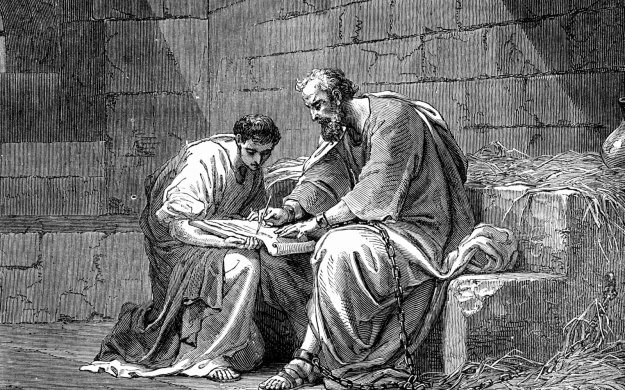
Paul the Apostle in Prison

“If the virgin birth is so important to Christians then why did the Apostle Paul not mention it any of his epistles?”

The New Testament is comprised of 27 books. Of those books the Apostle Paul wrote at least 13. In those books, he mentioned many of the important doctrines of the Christian faith. In his letter to the Corinthians, he says, “For I delivered to you as of first importance what I also received, that Christ died for our sins according to the Scriptures, and that He was buried, and that He was raised on the third day according to the Scriptures…” (1 Corinthians 15:3-4)

Here we see: 1)Christ dying for our sins, 2)that He was buried, 3)that He raised from the dead. In other books Paul writes about the deity of Jesus (Colossians 2:9, Romans 1:2-5, Philippians 2:6). But he never once mentions the virgin birth. Why?

Some argue that since what may be arguably the greatest evangelist and apologist of the Christian faith didn’t write about the virgin birth of Jesus that either he did not believe it or that he did not know about it. And that he was so knowledgeable it’s highly improbable that the latter is true. So, did Paul just not believe that Mary, the mother of Jesus, conceived Him as a virgin?

One thing we must remember is that just because he didn’t mention it doesn’t mean that he didn’t believe it. That’s like the common argument that since Scripture doesnt speak of Jesus preaching against x, then He must not have considered x a sin. But the Bible says that “Jesus did many other things as well. If every one of them were written down, I suppose that even the whole world would not have room for the books that would be written.” So just because we don’t know something didn’t happen doesn’t mean it didn’t happen. Likewise, just because Paul didn’t mention something doesn’t mean that he didn’t believe or that it’s not true.

It’s, in fact, more possible that Paul did know and believe in the virgin birth. The physician, known as Luke, was a companion of Paul during Paul’s second and third missionary journeys. Luke, who wrote the Gospel of Luke and The Acts of the Apostles, speaks of being there with Paul when meeting with the Jerusalem church in Acts 21. And while Paul wrote 13 books of the New Testament (14 according to some scholars), Luke’s two books contain more volume than Paul’s.

The reason I mention Luke is because he wrote about the virgin birth. The Gospel of Luke, chapter 1, verses 26-34 reads, “Now in the sixth month the angel Gabriel was sent from God to a city in Galilee called Nazareth, to a virgin engaged to a man whose name was Joseph, of the descendants of David; and the virgin’s name was Mary. And coming in, he said to her, “Greetings, favored one! The Lord is with you.” But she was very perplexed at this statement, and kept pondering what kind of salutation this was. The angel said to her, “Do not be afraid, Mary; for you have found favor with God. “And behold, you will conceive in your womb and bear a son, and you shall name Him Jesus. “He will be great and will be called the Son of the Most High; and the Lord God will give Him the throne of His father David; and He will reign over the house of Jacob forever, and His kingdom will have no end.” Mary said to the angel, “How can this be, since I am a virgin?”

Here we see that Luke clearly was aware of the virgin birth. Since we know that Luke and Paul were companions for quite a while, I believe it is safe to conclude that Paul also knew of the virgin birth. Also, Paul was no stranger to airing out his disagreements as he did in Galatians 2 about Peter. Luke also writes of Paul’s disagreement with Barnabas in Acts chapter 15. Therefore, I think it would be safe to assume that Paul or Luke would have written about a disagreement on the virgin conception of Jesus.

I also believe that Paul, in a roundabout way did mention the virgin birth. In the epistle to the Romans, Paul says, “Paul, a bond-servant of Christ Jesus, called as an apostle, set apart for the gospel of God,which He promised beforehand through His prophets in the holy Scriptures…” Paul, an educated man, knew the Hebrew scriptures, what we call the Old Testament. Paul calls himself a Pharisee in Acts 23:6 and Philippians 3:4-5. It was required of Pharisees to know the Hebrew Scriptures inside and out. Therefore, he knew the Old Testament book of the prophet Isaiah in which the virgin birth was first prophesied. Paul quoted Isaiah dozens of times in his writings so it wouldn’t be unwise to conclude that Paul also believed in that Jesus was conceived without an earthly father.

Therefore, by Paul being a friend of Luke and knowing the prophetic book of Isaiah, I would argue that Paul indeed believed in the virgin birth of Jesus. We need to be careful about not using the logical fallacy of arguing from absence (argumentum ad ignorantiam).

For more on the virgin birth, you can read my blog here.

Derrick Stokes
Theologetics.org

Hematidrosis: Did Jesus Sweat Blood?

Courtesy of Apologetics Press:

Dr. Dave Miller

Luke, the author of the New Testament books of Luke and Acts, who himself, by profession, was a physician. His writings manifest an intimate acquaintance with the technical language of the Greek medical schools of Asia Minor.

Of the four gospel writers, only Dr. Luke referred to Jesus’ ordeal as “agony” (agonia). It is because of this agony over things to come that we learn during His prayer “his sweat was as it were great drops of blood falling down to the ground” (Luke 22:44). Only Luke referred to Jesus’ sweat (idros)—a much used term in medical language. And only Luke referred to Jesus’ sweat as consisting of great drops of blood (thromboi haimatos)—a medical condition alluded to by both Aristotle and Theophrastus.1 The Greek term thromboi (from which we get thrombus, thrombin, et al.) refers to clots of blood.2Bible scholar Richard Lenski commented on the use of this term: “‘As clots,’ thromboi, means that the blood mingled with the sweat and thickened the globules so that they fell to the ground in little clots and did not merely stain the skin.”3

The Greek word hosei (“as it were”) refers to condition, not comparison, as Greek scholar Henry Alford observed:

The intention of the Evangelist seems clearly to be, to convey the idea that the sweat was (not fell like, but was)like drops of blood;—i.e., coloured with blood,—for so I understand the wJseiv, as just distinguishing the drops highly coloured with blood, from pure blood…. To suppose that it only fell like drops of blood (why not drops of any thing else? And drops of blood from what, and where?) is to nullify the force of the sentence, and make the insertion of aJivmato$ not only superfluous but absurd.4

We can conclude quite justifiably that the terminology used by the gospel writer to refer to the severe mental distress experienced by Jesus was intended to be taken literally, i.e., that the sweat of Jesus became bloody.5

A thorough search of the medical literature demonstrates that such a condition, while admittedly rare, does occur in humans. Commonly referred to as hematidrosis or hemohidrosis,6 this condition results in the excretion of blood or blood pigment in the sweat. Under conditions of great emotional stress, tiny capillaries in the sweat glands can rupture,7 thus mixing blood with perspiration. This condition has been reported in extreme instances of stress.8 During the waning years of the 20th century, 76 cases of hematidrosis were studied and classified into categories according to causative factors. The most frequent causes of the phenomenon were found to be “acute fear” and “intense mental contemplation.”9 While the extent of blood loss generally is minimal, hematidrosis also results in the skin becoming extremely tender and fragile,10 which would have made Christ’s pending physical insults even more painful.

From these factors, it is evident that even before Jesus endured the torture of the cross, He suffered far beyond what most of us will ever suffer. His penetrating awareness of the heinous nature of sin, its destructive and deadly effects, the sorrow and heartache that it inflicts, and the extreme measure necessary to deal with it, make the passion of Christ beyond comprehension.

ENDNOTES

1 William K. Hobart (1882), The Medical Language of St. Luke (Grand Rapids, MI: Baker, 1954 reprint), pp. 80-84.

2 W. Robertson Nicoll, ed. (no date), The Expositor’s Greek Testament (Grand Rapids, MI: Eerdmans), 1:631; M.R. Vincent (1887), Word Studies in the New Testament (Grand Rapids, MI: Eerdmans, 1946 reprint), 1:425.

3 R.C.H. Lenski (1961), The Interpretation of St. Luke’s Gospel (Minneapolis, MN: Augsburg), p. 1077.

4 Henry Alford (1874), Alford’s Greek Testament (Grand Rapids, MI: Baker, 1980 reprint), 1:648, italics in orig.; cf. A.T. Robertson (1934), A Grammar of the Greek New Testament in the Light of Historical Research (Nashville, TN: Broadman Press), p. 1140.

5 Cf. A.T. Robertson (1930), Word Pictures in the New Testament (Grand Rapids, MI: Baker), 2:272.

6 A.C. Allen (1967), The Skin: A Clinicopathological Treatise (New York: Grune and Stratton), second edition, pp. 745-747; “Hematidrosis” (2002),Dorland’s Illustrated Medical Dictionary, p. 832, https://goo.gl/U192fY.

7 R. Lumpkin (1978), “The Physical Suffering of Christ,” Journal of Medical Association of Alabama, 47:8-10.

8 See R.L Sutton, Jr. (1956), Diseases of the Skin (St. Louis, MO: Mosby College Publishing), eleventh edition, pp. 1393-1394).

9 J.E. Holoubek and A.B. Holoubek (1996), “Blood, Sweat, and Fear. ‘A Classification of Hematidrosis,’” Journal of Medicine, 27[3-4]:115-33. See also J. Manonukul, W. Wisuthsarewong, et al. (2008), “Hematidrosis: A Pathologic Process orStigmata. A Case Report with Comprehensive Histopathologic and Immunoperoxidase Studies,” American Journal of Dermatopathology, 30[2]:135-139, April; E. Mora and J. Lucas (2013),Hematidrosis: Blood Sweat,” Blood, 121[9]:1493,February 28.

10 P. Barbet (1953), A Doctor at Calvary: The Passion of Our Lord Jesus Christ as Described by a Surgeon (Garden City, NY: Doubleday Image Books), pp. 74-75; cf. Lumpkin, 1978.

http://apologeticspress.org/apcontent.aspx?category=11&article=1086