Busyness, Anxiety, and the Pursuit of Peace

Let me preface this by saying that I have no official training in psychology, psychiatry, counseling, or mental health. What I am about to write is purely based on my experience with human nature in my 40-plus years of living. It is not intended to be a substitute for actual biblical counsel or clinical help. Therefore, take this blog with a grain of salt.

Jesus with Martha and Mary by Gustave Dore

In recent decades, there has been an uptick in diagnoses in anxiety among those of us in the West. Even for those of us who haven’t been clinically diagnosed, there seems to be an underlying anxiety that pervades our everyday lives. While there are multiple angles from which we can approach the problem of anxiety, I believe one very real reason is our unending busyness.

The reason I call it “unending busyness” is that even in our relaxing, we remain busy. Our minds are constantly being stimulated when we should be truly at rest. We’ve become so accustomed to noise and chaos that we even need noise to help us sleep.

I believe since the advent of personal electronic entertainment; we have slowly begun to lose our personal mental peace. What started off as a handful of channels of broadcast television that we had to wait to watch when we got home or maybe saw as we shopped in a department store, then grew into more channels with cable and even more with satellite. With the convenience of the remote control, we could easily flip between hundreds of channels without having to get up. This instantly gave us access to all kinds of news, sports, shows, and movies at the push of a button. Then came the option to have a TV that showed one channel in a little box inside the picture of a separate channel.

We then move to having personal computers and the internet in our homes. So now, on one device, we have hundreds of TV channels, and on another device, we have an untold number of websites we can access. During this time, most computers had to be plugged into the 1 phone line of the house to access the internet. We went from needing to go to the library and search through countless books in order to do that research paper for school, to being able to Yahoo or Google whatever we wanted to know and having the results in a few seconds.

Since the time televisions made their way into our homes, we saw the invention of the grocery store, the interstate system, dishwasher appliances, the microwave, and all kinds of “instant” foods. This made wait times for almost anything in life much shorter than ever in human history and made life more effortless.

Enter the smartphone in the mid-2000s. Now, we have access to the internet, movies, and an interactive phone book in the palm of our hands. Not only that, but all members of the household also tend to have their own smartphones. There used to be one tv, one computer, and one phone line for multiple people, and everyone had to wait their turn. Now, there’s no need to wait. We don’t have to wait on letters from loved ones across the country or even across the world because we can DM them and get an instant response. We sit down after a hard day of work, and instead of letting our minds relax, we bombard it with news feeds and reels and images of more stuff we want to buy that we don’t need. We see other people post their personal drama, or we see other people post their vacations, which we wish we could be on because they look so peaceful (not knowing the anxiety they endured to get there).

Basically, our need to wait on things in life has dwindled drastically. We can get most of what we need or want with very little wait, if any. While I can appreciate all these things (I am using a smartphone to type this blog, BTW), life doesn’t really work that way. We feel like it does because of everything I mentioned above and some things I’m sure I failed to mention.

Because of the “instant” life we’ve become accustomed to over the past several decades, we think everything should be instant. We want to become healthy, but we don’t want to diet and exercise to get those results. That takes time, usually months and often years. And since it takes too much time, we choose not to do it, or we give up after a couple of weeks of seeing no results or we’d rather take diet pills instead. We want to get good grades, but we don’t want to sacrifice the time to sit and study the material. We don’t want to read books. We want to watch the 10-minute YouTube video about it. (We actually don’t want to watch the 10-minute YouTube video about it. We want to watch the 30-second TikTok video about it.) We want to be financially secure, but we don’t want to save and invest to have that financial freedom when we get older. We want big houses and nice cars early in life. We want the higher pay on our jobs without having to put in the long hours and move up the ladder (I’m not saying we shouldn’t all be paid a fair wage, but I do believe the wage should be commensurate with the amount of skill and training it takes to do the job).

I mentioned the interstate system earlier. In older cars, there used to be a designation at the 55 mph maker on the speedometer. That’s because the speed limit on America’s interstates used to be 55. Now, speed limits are 65, 70, and even 80 in some states. As Brooks said in The Shawshank Redemption, “The world went and got itself in a big d**n hurry.” If anything takes a minute or even a second longer than we think it should, we lose our minds.

So, this is what happens: You drive 10 miles an hour over the speed limit on the way to work, getting upset at the person in front of you actually going the speed limit. You’re irritable because you fell asleep with YouTube playing on your phone and America’s Got Talent on the TV at the same time, not letting our minds rest from the constant distraction. But, YouTube was really playing in a corner of the phone, and you got lost in the comments section of the latest political fiasco. Now you get to your understaffed place of work where you’re doing the jobs of 3 other people. Wait, Kevin called in again? He always calls in sick on payday! Ok, now you’re doing the job of 4 people. And of course, you remembered it was payday. You’ve been looking forward to payday since the day after last payday because you’ve accumulated way more expenses than your grandparents had. They were content with their one tv and one house phone and 2-bedroom house for a family of 5. Now, it’s after work, you’re tired, and you drive home 20 miles over the speed limit, knowing there’s a chance of getting pulled over by the police. Just the thought creates more unnecessary anxiety. Oh well, it’s just another stressor you’re willing to live with just for your ride to be over quicker. And of course, you’re thinking about all the responsibilities you have when you get home. Does any of that sound familiar?

As an adult, it seems that time flies by faster with each passing year. When we were growing up, time seemed to pass so slowly. But I think that possibly creates another kind of anxiety in children. They, too, are used to the fast paced instantaneous way of life, but at the same time, they have to wait for everything. Wait to be given permission. Wait till after dinner. Wait till they’re older. Wait till summer. Wait until the adults stop talking. The younger a child is, the less they understand the concept of time. The younger they are, the more they want whatever they want NOW. Yet our society and modern technology has somewhat enabled that they can, in fact, have it now. Whatever “it” may be. And we wonder why teenagers think we’re out of touch with reality if they’re told to wait till marriage to express one of their strongest and natural desires.

Therefore, I believe our desire to make things more convenient for us has caused us to become impatient. In our impatience, we have lost the ability to sit still, truly still. We have created too many distractions. With our distractions, we have become entirely too busy. We have become so accustomed to the chaos of busyness that our rest is seldom truly restful. And when we are truly resting, we are bored, fidgety, and needing something to stimulate us. Our anxiety never really leaves us.

I’m not saying that there aren’t truly people who suffer from very real anxiety due to perhaps chemical imbalance. Some types of anxiety may truly need medication to be helped. But I believe some anxiety can be helped, even possibly cured, if we choose to intentionally create times of quiet, times of reflection, of prayer, of meditation in our lives. What if we set our clocks for 10 or 15 minutes earlier and have that time dedicated to prayer and meditation? I’m not talking about praying while scrolling Instagram or Facebook. I’m not talking about meditation with the TV on in the background. Or what if on our commute to work, we turned the radio off and sat and listened quietly to what God has been trying to tell us? What if we made time during our lunch break to find a quiet place at work and catch up on some reading? What if we got home from work and made it a point to spend quality time with our families and acted as if there were no smartphones? What if we turned off the screens 30 minutes before bed so our brains could truly wind down? What if we chose to live more simply? What if you set timers on your favorite apps and/or video games in order to have quiet time? Look at your life and ask yourself what you could do to intentionally make peaceful moments every day in your life, however your life may look.

The main question is, what if we truly sought after God? What if we chased after God the way we chase after things? If you live a very busy life, putting away some distractions may be very hard to do at first. It may take some time to create a new normal. However, peace comes intentionally. Being still enough to hear God’s voice comes with intentionality because we may never hear it through all the noise. Understand that it may take some time, but anything good worth having is worth pursuing.

Read: Psalm 46:10, Philippians 4:6, Matthew 6:25-34, Luke 10:38-42

Derrick Stokes
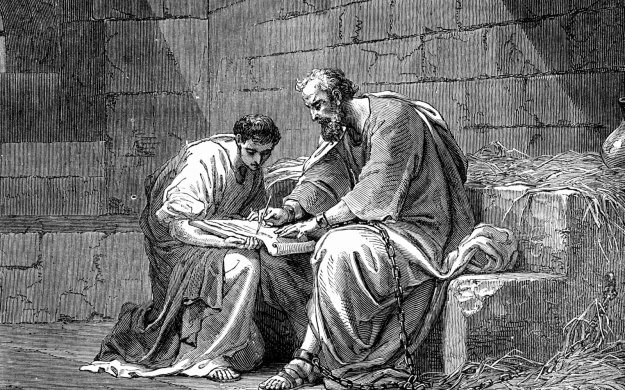
Paul and the Virgin Birth

Paul the Apostle in Prison

“If the virgin birth is so important to Christians then why did the Apostle Paul not mention it any of his epistles?”

The New Testament is comprised of 27 books. Of those books the Apostle Paul wrote at least 13. In those books, he mentioned many of the important doctrines of the Christian faith. In his letter to the Corinthians, he says, “For I delivered to you as of first importance what I also received, that Christ died for our sins according to the Scriptures, and that He was buried, and that He was raised on the third day according to the Scriptures…” (1 Corinthians 15:3-4)

Here we see: 1)Christ dying for our sins, 2)that He was buried, 3)that He raised from the dead. In other books Paul writes about the deity of Jesus (Colossians 2:9, Romans 1:2-5, Philippians 2:6). But he never once mentions the virgin birth. Why?

Some argue that since what may be arguably the greatest evangelist and apologist of the Christian faith didn’t write about the virgin birth of Jesus that either he did not believe it or that he did not know about it. And that he was so knowledgeable it’s highly improbable that the latter is true. So, did Paul just not believe that Mary, the mother of Jesus, conceived Him as a virgin?

One thing we must remember is that just because he didn’t mention it doesn’t mean that he didn’t believe it. That’s like the common argument that since Scripture doesnt speak of Jesus preaching against x, then He must not have considered x a sin. But the Bible says that “Jesus did many other things as well. If every one of them were written down, I suppose that even the whole world would not have room for the books that would be written.” So just because we don’t know something didn’t happen doesn’t mean it didn’t happen. Likewise, just because Paul didn’t mention something doesn’t mean that he didn’t believe or that it’s not true.

It’s, in fact, more possible that Paul did know and believe in the virgin birth. The physician, known as Luke, was a companion of Paul during Paul’s second and third missionary journeys. Luke, who wrote the Gospel of Luke and The Acts of the Apostles, speaks of being there with Paul when meeting with the Jerusalem church in Acts 21. And while Paul wrote 13 books of the New Testament (14 according to some scholars), Luke’s two books contain more volume than Paul’s.

The reason I mention Luke is because he wrote about the virgin birth. The Gospel of Luke, chapter 1, verses 26-34 reads, “Now in the sixth month the angel Gabriel was sent from God to a city in Galilee called Nazareth, to a virgin engaged to a man whose name was Joseph, of the descendants of David; and the virgin’s name was Mary. And coming in, he said to her, “Greetings, favored one! The Lord is with you.” But she was very perplexed at this statement, and kept pondering what kind of salutation this was. The angel said to her, “Do not be afraid, Mary; for you have found favor with God. “And behold, you will conceive in your womb and bear a son, and you shall name Him Jesus. “He will be great and will be called the Son of the Most High; and the Lord God will give Him the throne of His father David; and He will reign over the house of Jacob forever, and His kingdom will have no end.” Mary said to the angel, “How can this be, since I am a virgin?”

Here we see that Luke clearly was aware of the virgin birth. Since we know that Luke and Paul were companions for quite a while, I believe it is safe to conclude that Paul also knew of the virgin birth. Also, Paul was no stranger to airing out his disagreements as he did in Galatians 2 about Peter. Luke also writes of Paul’s disagreement with Barnabas in Acts chapter 15. Therefore, I think it would be safe to assume that Paul or Luke would have written about a disagreement on the virgin conception of Jesus.

I also believe that Paul, in a roundabout way did mention the virgin birth. In the epistle to the Romans, Paul says, “Paul, a bond-servant of Christ Jesus, called as an apostle, set apart for the gospel of God,which He promised beforehand through His prophets in the holy Scriptures…” Paul, an educated man, knew the Hebrew scriptures, what we call the Old Testament. Paul calls himself a Pharisee in Acts 23:6 and Philippians 3:4-5. It was required of Pharisees to know the Hebrew Scriptures inside and out. Therefore, he knew the Old Testament book of the prophet Isaiah in which the virgin birth was first prophesied. Paul quoted Isaiah dozens of times in his writings so it wouldn’t be unwise to conclude that Paul also believed in that Jesus was conceived without an earthly father.

Therefore, by Paul being a friend of Luke and knowing the prophetic book of Isaiah, I would argue that Paul indeed believed in the virgin birth of Jesus. We need to be careful about not using the logical fallacy of arguing from absence (argumentum ad ignorantiam).

For more on the virgin birth, you can read my blog here.

Derrick Stokes
Theologetics.org

The Virgin Birth

jesus-birth-james-schultz
Jesus’ Birth by James Schultz, 2017

The virgin birth of Jesus is one the main tenets of the Christian faith. This miraculous event is recorded in Scripture. Had Jesus not been born of the virgin Mary, He wouldn’t have been the proper sacrifice for our sins. He would have been born into sin and therefore would have sinned. According to the Old Testament, the sacrifice for sin had to be spotless and without blemish. Regarding Jesus, this doesn’t mean spotless physically. This means that He was without sin. His blood did not carry the sin trait that was borne to the rest of us from Adam.

What about His mother? Wasn’t she human born into sin? The Catholic doctrine of the Immaculate Conception teaches that Mary was born without sin in order for her to  conceive a sinless Christ. However, there is no biblical proof of the Immaculate Conception (which begs the question; wouldn’t the same logic require Mary’s mother to have been born without sin to conceive a sinless Mary, and her mother before her, and so on and so forth?). Mary needed saving from her sins like we all do. It was believed in the past that the baby in the womb shared his mother’s blood. What we know today, however, is that the baby when in the womb makes his own blood. His blood is unique to himself. That’s why Jesus’ blood, and Jesus’ blood only, has the power to wash away sins.  “The fetal blood and maternal blood do not mix. In fact, if this were to be the case, there would be such immunological protest from the mother that she would soon make enough antibodies to the baby’s blood to destroy the pregnancy.” (https://www.babble.com/pregnancy/anatomy-fetus-placenta/)

Jesus was unique in that His father was God. Although the Bible calls the nation of Israel the child of God in the Old Testament (Exodus 4:22, Deuteronomy. 14:1) and those that place their faith in Jesus are His children (Romans 8:16-17) under the New Covenant, only Jesus is called the “only begotten”. Jesus is God’s only son in the same way God called Isaac Abraham’s only son (Genesis 22:2) even though Abraham had another son (Ishmael) prior to Isaac. The Greek word for “only begotten” is monogenēs (μονογενής) which literally means “one of a kind” or “the only of its kind.” In the ancient near East, a person’s lineage was based on who their father was, not their mother. Jesus was, therefore, of His father and not of His mother. This also has scientific bearing today. As this article from Discover magazine puts it “You may have inherited your mother’s eyes, but, genetically speaking, you use more DNA passed down from your father.” If Jesus was born of Joseph and Mary, He could not have been the only begotten son.

One of the main arguments against the virgin birth is that the word for virgin in the Book of Isaiah means “young girl” or “maiden”. Thus the prophecy only means that the Messiah would be born to a young girl.

This argument, however, fails to take a few facts into consideration. In Isaiah chapter 7, verse 14, the prophet foretells of the future Messiah being born of a virgin. The Hebrew word for virgin here is עַלְמָה or “almah”. Almah literally means “a virgin, maiden, a young woman of marrying age.” People dismiss that almah can mean virgin and say that it just means a young woman. And that Mary was just a young “betrothed” woman, not a virgin when she conceived Jesus. However, nowhere in the Hebrew scriptures does “almah” denote a young woman who is not a virgin.

An important part of understanding scripture is to understand what other scriptures say concerning the same topic. Let’s just say that we can’t tell whether Isaiah 7:14 is speaking of a virgin or just a young woman. Well we look to see how the authors of the New Testament would have read it. Matthew 1:22 is proof that the Jews of the time knew Isaiah 7:14 was speaking of a literal virgin and Matthew shows that Jesus is the fulfillment of this prophecy. When the angel Gabriel announced to Mary that she would conceive a child, she said “How can this be, since I am a virgin?” If she were just a young and married woman, it would not have come as such a surprise to her. Gabriel also would not have had to say that the child would be conceived of the Holy Spirit. No other place in scripture describes a birth in this fashion. The prophet Samuel was a “miracle child” but scriptures plainly tells us that his parents “knew” each other before he was born (1 Samuel 1:19). Samson was a “miracle child” but He was not conceived of the Holy Spirit or born of a virgin. Isaac was a miracle born to Abraham and Sarah, not because Sarah was a virgin, but because she was too old too conceive.

The whole purpose for the virgin birth, the whole purpose for the incarnation, was the cross. Actually, it was love that led to the cross. The cross is of much importance because of Who was hung on the cross. It was God who became a man. Born of a virgin. Laid aside heavenly pleasure for the likes of earthly pain. Only God could do this. Only He could be the sacrifice for our sins.

As C.S Lewis says, “Now if we had not fallen, that would all be plain sailing. But unfortunately we now need God’s help in order to do something which God, in His own nature, never does at all – to surrender, to suffer, to submit, to die. Nothing in God’s nature corresponds to this process at all. So that the one road for which we now need God’s leadership most of all is a road God, in His own nature, has never walked. God can share only what He has: this thing, in His own nature, He has not.
But supposing God became a man – suppose our human nature which can suffer and die was amalgamated with God’s nature in one person – then that person could help us. He could surrender His will, and suffer and die, because He was man; and He could do it perfectly because He was God. You and I can go through this process only if God does it in us; but God can do it only if He becomes man. Our attempts at this dying will succeed only if we men share in God’s dying, just as our thinking can succeed only because it is a drop out of the ocean of His intelligence: but we cannot share God’s dying unless God dies; and he cannot die except by being a man. That is the sense in which He pays our debt, and suffers for us what He Himself need not suffer at all.”

Further reading: Hebrews 7:26, Romans 5:12,17,19

Derrick Stokes
Theologetics.org