Why Doesn’t God Forgive Sin Without a Sacrifice?

If God can do anything He wants, why doesn’t he just forgive sin? He’s all-powerful. He’s the epitome of love. So, why did He need a sacrifice for sin? Why doesn’t He just say to everyone, “Poof your sins are forgiven!”

The Return of the Prodigal by Rembrandt

In the beginning, we are told that God gave mankind one rule: don’t eat the forbidden fruit. We only had that one rule. We still disobeyed. God drove man from His earthy temple, Eden, but not before telling them a promise. We’ll get back to that promise later.

Why would God need to send them away, though? Couldn’t He just have said, “I forgive you. Don’t do it again. Stay and enjoy paradise”? Furthermore, later in Scripture, we are told that God requires us to forgive someone who sins against us, and if we don’t, then He won’t forgive our sins. But wait. Why do we have to be the first to forgive? Is that even fair?

Well, I believe that to understand this, we must first understand who God is and who we are in relation to God.

God, who is the most perfect being, created man. Man is not a perfect being. As I stated earlier, the earliest man couldn’t even keep one rule. God is all-powerful (omnipotent), all-knowing (omniscient), and the ultimate goodness (omnibenevolent). Man is none of these things. We can only know so much, do so much, and have a limit on how good we can be. God, because of His omnibenevolence, cannot sin. Since we do not have that attribute, we do sin.

To illustrate my point, let’s say I kicked a small rock down the road. It’s not a being that can not feel or think because it’s incapable of life. I’ve done no wrong. Now, let’s say I’ve kicked a bug that wasn’t bothering me. I’ve likely caused it harm or even killed it, and this action probably speaks negatively about my character. But it basically stops there. Now let’s say I continue down the road and I see a dog and decide it’s a good idea to kick it. Well, if it doesn’t bite me, I could actually be charged with animal cruelty in many places and if it’s someone’s pet, the dog has more intrinsic value bestowed on it, and I could get in trouble with its family also. There would be even more trouble for me if I chose to kick one of the dog’s human owners.

Basically, as I moved up the “hierarchy” of existing things, I committed more of a trespass against each thing. Even if I was never caught, most people would probably agree that some cosmic or divine justice would (or at least should) await me for my moral failing. The higher the being, the more I would be indebted to some sort of restitution even if it’s just an apology.

This brings me to my point. Our trespasses (sins) against a Being who exists in infinite goodness increases because of who He is. The increase is so much that an infinite punishment is the only justified payback.

When man sins against man, the debt is much less than when man sins against God.

Jesus told a story about a master who called his servant to him to settle an outstanding debt he owed the master. The servant begged and pleaded that the master would be merciful, and the master was. Later, the servant sees another servant who owed him much less than the first servant owed his master. The second servant begged for mercy, to which the first refused to listen and had his family thrown into prison until he received his money. The king heard about the incident. “You wicked servant! I forgave you all that debt because you pleaded with me. And should you not have had mercy on your fellow servant, as I had mercy on you?” He then had the servant thrown into prison until he could repay the debt. (Read Matthew 18:23-34).

Immediately before Jesus told this story, his apostle Peter asks how often he should forgive his brother if his brother sins against him. “As many as seven times?” Peter inquires to which Jesus answers, “not seven times, but seventy-seven times.” Some translations say seventy times seven. By following up Peter’s question with the above story, Jesus illustrated that sins against the Master are exponentially greater than sins against each other.

When you read the parable, take note of the amount that the servant owed his master: 10,000 talents. A “talent” was twenty years wages. Twenty years!! One talent=20 years wages. This man owed 10,000 talents to his master. That’s 200,000 years of wages he owed. There was no earthly way that this man could have repaid that debt. The amount his fellow servant owed him was worth only a few hundred days of work.

You may ask, “Since Jesus told the story, and He said that the master was just going to forgive the servant, why can’t God just forgive us?” The point of the parable was to show how our sins against each other pale in comparison to our sins against God. But it does remind us that God is merciful.

I’ve mentioned that God is all-powerful, all-knowing, infinitely good, and merciful. I must add that His goodness goes hand in hand with another attribute, His justice. As a good and just judge, he must punish wrongdoing. Otherwise, he is neither good nor just. Take a moment and think about some of the bad things you’ve done in life knowing what the punishment could have been, and you still proceeded to do the evil deed. How brazen we can be! Now imagine the only “punishment” awaiting our evil deeds was God saying, “Ahh, it’s all good! Just don’t do it again!” You better believe we’re gonna do it again! So, since it’s not “all good,” He punishes because He is all good. And since He is all-good, He still makes a way for us. How? He paid our debt, nailing it to the cross of Christ. (Colossians 2:14)

In conclusion, since God is the highest being (The Most High), any sin against Him is of the highest offense. Any sin man commits against his fellow man is not. Therefore, God does not have to forgive us just because He is good. Instead, because He is good (and just), He must punish sin. However, the good news is that Jesus, the promise God told Adam and Eve, took our penalty for sin on His own back by dying on the cross. The ultimate goodness took on the ultimate punishment. Those who repent and believe this are forgiven and free. And if you are forgiven, you must forgive others.

Derrick Stokes

Theologetics.org
God’s Attributes Devotional (Free)

Introducing our FREE 1 month Devotional! It’s based on our God’s Attributes poster that can be found and also downloaded for free. We pray this devotional not only informs but draws each reader closer to their Creator. Don’t forget to share it with others!


https://theologetics.org/wp-content/uploads/2021/10/derrick-devo-33-attributes-of-god.pdf

What Do You Mean By “God”? Defining Terms

When having interfaith dialogues, the word God is often thrown around. “You believe in God? I believe in God!” When in actuality, the “God” spoken of is totally different in the eyes of the respective believer. So it is imperative in these conversations to “define terms”. Ask what does a person mean by God. Ask them who they believe God is.

It’s often said that Christians and Muslims worship the same God. However, the Muslim God has no Son unlike the Christian God. Muslims believe in “Jesus” but their Jesus was not crucified and therefore did not die for the sins of the world. Of course, the Christian Jesus did. These are, in no way, minor differences.

The Mormon god was once a man who is currently married to his heavenly wife. This is a different god.

Jehovah’s Witnesses believe that Jesus is not God but is, instead, the archangel Michael. In Mormonism, he is the spirit child of “God” and his wife and is the brother of Lucifer. This is a drastically different Jesus. Yet, both Jehovah’s Witnesses and Mormons consider themselves Christians.

Many Arabic speaking Christians call God “Allah”. Muslims call their’s “Allah”. It is not the same “Allah”. Though many would have us believe it is.

Many religious groups other than Christians use the term God when speaking of their own deities. Often it is used as a generic term. Even in Christendom, God is actually a title and not a name for Yahweh (YHVH from the Hebrew יהוה). The word “God” actually comes from the German “Gott”.

To some people “God” may just mean some non-personal energy or just the material universe itself. To others we human beings make up the collective “God consciousness”.

To have clear and concise communication in theological discussions, defining terms can make the difference between what we agree on and what we disagree on. It lays the foundation. Understandably, we won’t always be right in everything we discuss. But making the differences known from the beginning can get to the root of the issue.

Derrick Stokes
Theologetics.org

The 2nd Hidden “Verse” about Jesus in Genesis

Descent-from-the-Cross
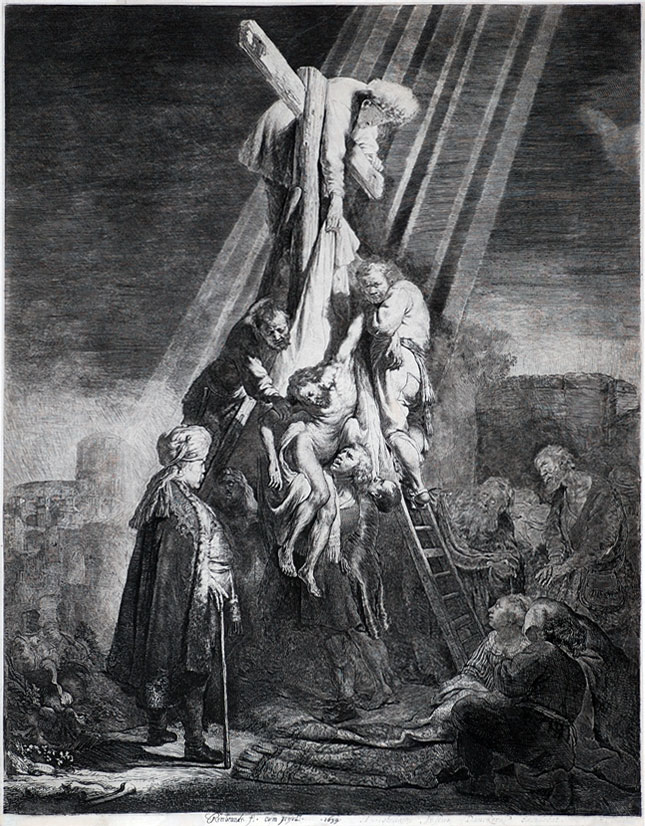
Rembrandt, The Descent from the Cross: the Second Plate, Date
1633


It is incredible to think, that the God who created the entire universe by speaking it into being, would love us and want to know each one of us on a personal level. And that this same God inspired various imperfect people from all walks of life to write about his love for us in a collection of ancient manuscripts we call the Bible. But it’s not only that his love was written about and revealed to us but when you dig into the original languages the Bible was written in, you can see the story of Jesus thousands of years before he was even born hidden in unique ways.

It is more apparent to me today than it has ever been that God is incredibly multi-faceted, so much more than 3-dimensionally and I feel like the more I learn about the Bible the more this can be clearly seen. One example of this is a previous blog we wrote that talks about the hidden “verse” about Jesus in Genesis 5 which outlines the various definitions of the names of the line of Adam to Noah which reads much like a Messianic prophecy. This blog is similar in that it outlines various definitions of the names of the twelve sons of Jacob which has another amazing resemblance to the story of Jesus. I was first made aware of this from something someone else posted on social media.

Lets begin…

Genesis 29:31-35, 30:1-24, and 35:16-18 describes the 12 sons of Jacob who would become the fathers of the 12 tribes of Israel. The following are a list of the 12 sons in order of birth with meanings of each name listed next to it;

1 Reuben – Behold A Son, Son Of Vision, Son Who’s Seen
2 Simeon – Hearing, He Who Hears, Man Of Hearing, Hearing With Acceptance
3 Levi – Joined, Adhesion
4 Judah – Let Him (God) Be Praised, Praised
5 Dan – Judge, Judging
6 Naphtali – My Wrestling
7 Gad – Good Fortune, Harrowing Fortune
8 Asher – Happy, (happiness, to be right in the eyes of someone, to obtain this person’s approval)
9 Issachar – Man Of Hire, He Is Wages, There Is Recompense
10 Zebulun – Glorious Dwelling Place, a rather reserved Dwelling, Wished-For Habitation
11 Joseph – Increaser, Repeater or Doubler, May He (Yahweh) Add, He Shall Add, He Adds, Increases, May God Add
12 Benjamin – Son (building block) Of The Right Hand (of God)

Each name has multiple meanings and even different roots. Taking into consideration that some of the names clearly describe God and others describe man, one translation of each of the twelve names, one name after the other, reads in this way:

“Behold a son who hears with acceptance, joined to (us), let Him be praised. A judge of my wrestling bringing good fortune to obtain His approval. He is wages (for) a glorious and reserved dwelling place. He shall add (us) son(s) of his right hand.”

Now, Hebrew to English is a little rough to begin with but the main idea is pretty clearly seen even without the added pronouns and conjunctions to aid in connecting the words. This isn’t to say these are the only meanings of the names, some may not even be the primary meanings but it’s amazing that God had Jacob give his children names that could be translated in a way that shows the story of Jesus coming to offer salvation to the world!

http://www.abarim-publications.com/Meaning/Reuben.html#.WYqGk4okqRs
http://www.abarim-publications.com/Meaning/Simeon.html#.WYqGuookqRs
http://www.abarim-publications.com/Meaning/Levi.html#.WYqG14okqRs
http://www.abarim-publications.com/Meaning/Judah.html#.WYqG9IokqRs
http://www.abarim-publications.com/Meaning/Dan.html#.WYqHDookqRs
http://www.abarim-publications.com/Meaning/Naphtali.html#.WYqHKYokqRs
http://www.abarim-publications.com/Meaning/Gad.html#.WYqHSookqRs
http://www.abarim-publications.com/Meaning/Asher.html#.WYqHYIokqRs
http://www.abarim-publications.com/Meaning/Issachar.html#.WYqHf4okqRs
http://www.abarim-publications.com/Meaning/Zebulun.html#.WYqHnookqRs
http://www.abarim-publications.com/Meaning/Joseph.html#.WYqH3ookqRs
http://www.abarim-publications.com/Meaning/Benjamin.html#.WYqH9ookqRs

Clark Campbell
Theologetics.org

Universalism: All will be made alive?

Teachings_of_Jesus_38_of_40._the_rapture._one_in_the_field._Jan_Luyken_etching._Bowyer_Bible
The Rapture: One in the Field by Philip Medhurst, The Bowyer Bible, 1795

Universalism is the belief that all people will eventually get to heaven. It has gained some popularity lately in some Christian circles. But is this view biblical?

1 Corinthians 15:22 says “For as in Adam all die, so also in Christ shall all be made alive.”(ESV)

The historical Christian view on the state of mankind is that because of the sin of Adam, ALL people stand condemned and are in need of the gift of salvation that only comes through the obedience of Jesus Christ. That this gift is effective to ONLY those to accept the free give of salvation, and those who reject the gift will not enter into heaven. This is the opposite of universalism.

Does this verse in 1 Corinthians state otherwise? Does this verse support universalism?

The verse in Greek is “ωϲπερ γαρ εν τω αδαμ παντεϲ απο θνηϲκουϲιν  ‾‾ ουτωϲ και εν τω  χω παντεϲ ζωο ποιηθηϲονται” . The word “παντεϲ“, transliterated pantes, means all.  So what are we to take from this verse? Will all of mankind receive salvation no matter what we do or what we believe?

Does all mean all all of the time?

In a sense, yes. All shall be made alive. But the word all always has a qualification (or quantification). We have the macro (total) “all” verses the micro (some of the total) “all”. If I were to say, “I ate all the grapes”, no one would think that I ate all the grapes that exist in the world (macro). I would have to mean all the grapes that were in the refrigerator or all the grapes I had in the bowl (micro). That not one grape that was in my possession, or domain, was left uneaten. So how does this apply to 1 Corinthians 15:22?

Adam and Eve were the first humans created. All of mankind born after them came from them. Because of their sin, all of mankind has come into the world sinful. We are sinful because of Adam’s sin. This is known in theology as imputation. As BibleStudyTools.com defines imputation “the sin of Adam is imputed to all his descendants, i.e., it is reckoned as theirs, and they are dealt with therefore as guilty.”¹ This applies to all of us. The totality of humankind. In Adam all die…

However, in Christ all shall be made alive.

Notice the words “in Christ”. The Greek word “εν” literally means in. In the Nativity it is used to describe how Mary was with child; literally “in womb was child.” Reality tells that not everyone is “in Christ.” Most people reject Him as their Savior. So the all in the second part of verse 22 is not referring to all people but all who are “in Christ”. As in Adam all (macro) die, so in Christ all (micro) shall be made alive. All who are in Christ are imputed with His righteousness.

For further understanding let’s let scripture interpret scripture by looking at the surrounding context.

1 Corinthians 15:17-23
17. And if Christ has not been raised, your faith is futile and you are still in your sins.

18. Then those also who have fallen asleep in Christ have perished.

19. If in Christ we have hope in this life only, we are of all people most to be pitied.

20. But in fact Christ has been raised from the dead, the firstfruits of those who have fallen asleep.

21. For as by a man [Adam] came death, by a man [Jesus] has come also the resurrection of the dead.

22. For as in Adam all die, so also in Christ shall all be made alive.

23. But each in his own order: Christ the firstfruits, then at his coming those who belong to Christ.

24. Then comes the end, when he delivers the kingdom to God the Father after destroying every rule and every authority and power.

25. For he must reign until he has put all his enemies under his feet.

“Those who belong to Christ”. That’s who all means in the second part of verse 22. Unless we are in Christ then we are still in sin and we remain His enemies. Therefore, this verse can not be applied to support universalism.

So lastly and of most importance, are you in Christ? Are you still dead in your sins and an enemy of Christ? Or have you placed your trust in Him? Have you received His free gift of salvation?

Further reading: John 5:24-26, Romans 5:12-21, 1 Corinthians 15:45-49

¹A broader definition would be “to charge to one’s account” as in Philemon 18 where Paul asks that Onesimus’ debts be charged to Paul

Derrick Stokes
Theologetics.org

Isaiah Believed the Earth was Flat?

Schnorr_von_Carolsfeld_Bibel_in_Bildern_1860_004
The Fourth Day of Creation (woodcut by Julius Schnorr von Carolsfeld from the 1860 Die Bibel in Bildern)

Isaiah was inspired by God to write the book of Isaiah in the Bible and it is a book that has many prophecies in it, many of which Jesus fulfilled with His life and death which we won’t go into now. Now there are many arguments circulating today that attempt to disprove the Bible. Some have obvious flaws while others may take knowledge about the original language, Biblical history or theology to show their flaws. The Bible claims to be the inspired word of God, written by men which God used to tell us the story of His plan for all mankind. It is without error in its original writings and because of these claims, if they were not true, the Bible would have errors and could be shown to be false. One argument that I have personally come across is that Isaiah believed the earth was flat.

There are at least two verses which have been used to make this claim so lets look at the first verse.

It is He who sits above the circle of the earth,
And its inhabitants are like grasshoppers,
Who stretches out the heavens like a curtain,
And spreads them out like a tent to dwell in.

Isaiah 40:22 (NKJV)

Now the argument used for this verse is that if Isaiah knew the earth was a globe at the time he penned the book of Isaiah, he would have used a word like “globe” or “ball” but he used “circle” which is two dimensional and flat.

Now lets look at the second verse.

He will set up a banner for the nations,
And will assemble the outcasts of Israel,
And gather together the dispersed of Judah
From the four corners of the earth.
Isaiah 11:12 (NKJV)

The argument used for this verse is that Isaiah didn’t believe the earth was a sphere but that it was a flat square or rectangle with four corners.

For someone to say Isaiah believed the earth was flat based on these verses alone would likely require an eisegesis of the text rather than an exegesis which means the person making the claim is imposing his or her interpretation onto the text instead of drawing out the meaning in accordance with the context.

It is more likely these two arguments are both false and one reason why is that they were both written by Isaiah. Why would the same person write about the earth being a flat square and a flat circle? It is more likely Isaiah didn’t believe the earth was flat at all. When he wrote of the four corners of the earth, Jewish readers would have understood he was speaking about ‘everywhere on the earth’ or ‘from all directions’ which among other things is briefly discussed here http://creation.com/are-biblical-creationists-cornered-a-response-to-dr-jp-moreland.

And the circle of the earth could have meant a sphere. The original word in Hebrew was chuwg which can mean circle, circuit, compass and one translation cites sphere but even if it didn’t, from a distance (like the earth from space) a sphere would be viewed as a circle from all directions so using a word that means circle logically does not negate the earth being a sphere.

So, while there are some seemingly convincing arguments out there that attempt to disprove the Bible, a closer examination will show that the Bible is what it claims to be; the Inspired Word of God!

Also see
http://www.icr.org/article/circle-earth/

Clark Campbell
Theologetics.org

Jonah prophesied and it did not come true?

Jonah
Jonah and the whale (Jonah 2:11) by Matthaeus Merian I (1630)

I was doing some reading in a new book my wife got me which gives background information about every book in the Bible as well as the Apocrypha. Despite a wealth of interesting and be it “sound” information, are some things which I found a little less than accurate. One of these things is that it states there was only one prophecy in Jonah and it didn’t come true.

So lets take a look at this prophecy.

Jonah 3:4 says Jonah began by going a day’s journey into the city, proclaiming, “Forty more days and Nineveh will be overthrown.”

Another translation is: On the day Jonah entered the city, he shouted to the crowds: “Forty days from now Nineveh will be destroyed!”

So what’s the issue? Nineveh was never destroyed because the people repented and turned from their evil ways.

Well, having a prophet of God get a prophecy wrong would essentially mean God misspoke, or at the very least, Jonah did which would mean the Bible was possibly wrong in relaying God’s intent which comes with a whole new set of issues.

Well, it turns out the original word in Hebrew for overthrown is “haphak” and it can also mean “to turn, turn around, to change and transform”.

So amazingly, because of the Hebrew language and God’s Omniscience, God used Jonah in a way I never even realized. The overthrowing of Nineveh by their destruction turned into the transforming of the city by turning from their sin!!!

It’s astounding how this one word “haphak”, and this one prophecy, could mean two seperate options at the same time which were dependent on the reaction of a city to God’s prophet. The more I learn about the God we serve, the more I am amazed and the more I fall in love with His heart for us.

If you too want to learn more about the God of the Bible, email us at Theologetics3.15@gmail.com

-Clark Campbell
Theologetics.org

What Believing in Evolution Actually Means

Earth
The geocentric model according to the Bible of Martin Luther.

There is no denying it, micro-evolution exists, although the term itself is quite misleading. Micro-evolution is a term that is commonly used to describe adaptation within a species to help them survive. These adaptations never result in a new species, there is not even one piece of observable scientific evidence to suggest otherwise. Adaptations always result in the same or less information within that species DNA code and for macro-evolution to occur would require new information which simply does not happen.

This blog is not meant to be about the absurdities of macro-evolution. There are great resources out there that go in to much detail about micro and macro-evolution from a Biblical standpoint (Mike Riddle and Answers in Genesis are two resources that immediately come to mind but there are many more). This blog is about what it means for a Christian to believe in macro-evolution (which I will simply call evolution from here on out). So it is my hope that if you have read this far, you will find this helpful and not hurtful.

For a Christian to believe in millions of years of evolution means:

1. The authority of scripture is compromised since the writing style of Genesis is “historical narrative” and not poetry:

The normal order for a Hebrew narrative sentence is:
Conjunction–Verb–Subject–Object.

The order in poetic writing is:
Subject–Verb–Object

The style of writing of Genesis 1 is historical, using the waw-consecutive to express consecutive action (waw = and).

http://www.ldolphin.org/genmyth.html

So for example, if I were to choose to believe that the creation account is not really a literal six day event as recorded in Genesis but a figurative allegorical story, that would be similar to me believing Jesus was not really a literal man but a figurative fictional character. It would be one thing if Genesis were written as poetry but the fact is, it was not. If I were to treat it like it is poetry and not literal, what stops me from doing the same thing with the rest of the Bible?

2. To believe in evolution means man wasn’t made distinct from the animals as recorded in Genesis but is an animal.

“Then God said, “Let us make man in our image, after our likeness. And let them have dominion over the fish of the sea and over the birds of the heavens and over the livestock and over all the earth and over every creeping thing that creeps on the earth.””
Genesis 1:26

“then the LORD God formed the man of dust from the ground and breathed into his nostrils the breath of life, and the man became a living creature.”
Genesis 2:7

The Bible teaches that God made us unique, that there was a distinct moment where we were created in God’s image. Not slowly becoming more human, and thus, more like God over millions of years.

3. To believe in evolution means Eve would not have been made as a help-mate for Adam from his rib.

“20 The man gave names to all livestock and to the birds of the heavens and to every beast of the field. But for Adam there was not found a helper fit for him.
21 So the LORD God caused a deep sleep to fall upon the man, and while he slept took one of his ribs and closed up its place with flesh.
22 And the rib that the LORD God had taken from the man he made into a woman and brought her to the man.”
Genesis 2:20-22

Again, the Bible lays it out clearly, man was literally alone and God took part of Adam to provide a suitable mate for him since no creature that already existed was fit to fill that void.

4. To believe in evolution means thorns, disease, and death would have existed before Adam and Eve since fossils (supposedly existing millions of years before Adam and Eve) show thorns, disease, and death; all of which should have only happened after Adam and Eve sinned.

“And God saw everything that he had made, and behold, it was very good. And there was evening and there was morning, the sixth day.”
Genesis 1:31

“16 And the LORD God commanded the man, saying, “You may surely eat of every tree of the garden,
17 but of the tree of the knowledge of good and evil you shall not eat, for in the day that you eat of it you shall surely die.””
Genesis 2:16-17

“17 And to Adam he said, “Because you have listened to the voice of your wife and have eaten of the tree of which I commanded you, ‘You shall not eat of it,’ cursed is the ground because of you; in pain you shall eat of it all the days of your life;
18 thorns and thistles it shall bring forth for you; and you shall eat the plants of the field.”
Genesis 3:17-18

Using faulty dating methods, the fossil record is believed to show death and disease existing way before Adam and Eve would have existed. But in Luke 3:23-38 it shows Jesus’s bloodline all the way back to Adam who is portrayed as a literal man. This bloodline places Adam roughly 6,000 years ago. If Adam existed 6,000 years ago but we have fossils supposedly hundreds of thousands to millions of years old that show thorns, disease, and the death of humans and animals, then the Bible would simply be wrong. There is no combining evolution and the Bible, there are logical and scientific ways to show that the Biblical account of creation is the most likely and that the scientific assumptions and dating methods currently used today are false.

5. If humans merely evolved instead of being created the way the Bible says we were, that means God used death to create us and it had nothing to do with Adam and Eve’s sin which seems to negate our need for a savior.

“Therefore, just as sin entered the world through one man, and death through sin, and in this way death came to all people, because all sinned–”
Romans 5:12

I know there are Christians out there; sincere, God-fearing, and Jesus-loving Christians, who hold to the belief that God used evolution to create us. Aside from a lack of true evidence, it seems to me that it is a serious compromise of the authority of Scripture to hold such a view. I hope this blog has given food for thought to any Christian with a theistic-evolution viewpoint or any Christian who hasn’t really considered how to reconcile evolution and the Bible. I do not mean to try and condemn anyone, only to point out what seems like the logical conclusions of a theistic-evolution worldview.

By Clark Campbell
Theologetics.org

Why Didn’t God Make Us Perfect Without Sin?

satan-fall-milton
Gustave Doré (engraving); Satan, the Fallen Angel, is flung from Heaven and nears the confines of the Earth on his way to Hell [Paradise Lost, John Milton; 1667]; c. 1866.
God is perfect and God is holy.

So why didn’t God make humans and angels perfect so that they would never sin?

If we can even deduce this, the following are some of the questions I would consider to help us understand why God didn’t make us perfect:

A. Could God have created a perfect being with free will that would never sin?
B. In heaven, will we lose our free will or will it still be possible for us to sin?
C. Why did Lucifer sin in the first place?

D. Why does God allow sin?


A. Could God have created a perfect being with free will that would never sin?

Consider Philippians 2:5-7
“5
Have this attitude in yourselves which was also in Christ Jesus, 6who, although He existed in the form of God, did not regard equality with God a thing to be grasped, 7but emptied Himself, taking the form of a bond-servant, and being made in the likeness of men.…”

Now it seems as though even Jesus Himself outlined human equality with God something that cannot be attained and Jesus was man and God! (This concept of Jesus being 100% man and 100% God is confusing but a brief explanation can be found here under Jesus’ Humanity & Eternality)

Also consider that the question “Could God have created a perfect being with free will that would never sin?” seems to cause an issue; If God were to create a perfect being with free will that never sinned, then it is possible He would in one sense have created a being that was equal to God (at least on some level). A being that is perfect without sin would also be holy, so this seems to indicate that He would have just created another God (this is assuming that perfection is all-encompassing).

Now, this thought process implies that what makes God God is His being perfect and holy. This may not be entirely true since God is more than perfect and holy. There is also His eternality, aseity, necessity, and a list of other characteristics you can find here but it is worth thinking about.

Someone may ask, “If it’s true that God wouldn’t make someone perfect to begin with, how is it possible to become perfect in heaven?” Well, the saints (those who accept Christ as Lord and Savior) were not created perfect but have been perfected by the blood of Jesus. A caterpillar does not become a new creature when it transforms into a butterfly. It’s existence doesn’t cease, it is in a sense “perfected”. The Christian does not cease to be one creation and enter into a different existence. It transforms into perfection.

So, it seems that we will possibly be transformed into perfection in heaven but not into perfect beings, at least not perfect like God is perfect so there seems to be a difference.

B. In heaven, will we lose our free will or will it still be possible for us to sin?
&
C. Why did Lucifer sin in the first place?

One would assume that in heaven, we will know God and His perfectness. That we would still possess free will so to speak but we would never want to deny our Creator because of our knowledge and love of Him? This has been the explanation I have always believed but it still seems like it circles back to the question; Why in heaven would Lucifer sin being in what seems like a similar situation?

I personally believe the answer to question B. is no we will not lose our free will but we won’t want to sin. One reason presented to me for why we could possess free will in heaven and never sin is that we will likely know the difference from being in a place where suffering and pain exists to being in a place where it does not (somewhat separated from God’s presence on earth at God’s discretion). Lucifer had no such knowledge. So it is possible Lucifer ignorantly thought he could take God’s place and it subsequently got him and all the angels who took his side thrown out of heaven because of it. But what could have started this “chain reaction” so to speak?

I have written before about my personal thoughts on sin and/or evil possibly being the direct result of God’s absence but I recently read an article by John Piper (Where Did Satan’s First Desire for Evil Come From?) about an idea worth pondering; that basically God’s glory somehow being hidden from Lucifer may explain Lucifer’s initial desire to “be” God. So maybe, while Lucifer didn’t know what we know about the ugliness involved in the separation from God, some degree of separation may have sparked the flame within him. This is not to say that it is absolutely how it happened, it is just a possibility. Why would God do that to begin with you may ask? I will give my explanation in the next section.

D. Why does God allow sin?

God is perfect and God is holy. He created us with the sin plan. Somehow this is better than making us perfect without sin. I believe that the reason why it is better is evident in the Genesis account of God making the Tree of the Knowledge of Good and Evil for Adam and Eve, and even before with Lucifer by possibly hiding His glory from Lucifer so he and all of creation could experience an unforced choice to love God which seems to require free will.

Another article I read by

So, all things considered, it appears that God created humans and angels with the ability to sin (freely deny Him) because He wanted us to be able to love. God did not want robots, after all, so He allowed himself to be hidden just enough that we must choose to believe, follow, and love Him. It is the sad reality that sin separates us from God. God does not want us to be separated from Him but because of the gift of free will which God has given each of us, we can choose to live a life without Him. Because God is holy, He cannot give anyone a “free pass” and let sin go unpunished but the good news is that someone already bore your punishment for you and His name is Jesus! All you need to do is accept His gift and turn from your sin. It is my prayer that you choose to do so right now, because you may not get another chance tomorrow and there is nothing worse than a lack of God for eternity.

By Clark Campbell with input from Derrick Stokes and Paul Grodell
Theologetics.org

Thoughts, Prayers, Amens and Lies

Praying-Child
Jacques Hnizdovsky (1915-1985) Praying Child Notecard

I had a discussion about prayer with a few individuals online that brought up some interesting ideas, this is just part of that conversation. It all started when this statement was made:

Person A “Any of us who tweet or post “prayers” for people in tragedy and do not follow through on them are in sin. Any of us who merely tweet or post “thoughts” going out to people in tragedy are painfully mistaken. And any of us who broadly dismiss the honest prayers for people in tragedy are tragically blind to true power.”

Now this first statement seemed pretty straight forward to me and a rather truthful statement as well but the conversation that ensued brought up some interesting questions about prayer.

Person BJust making the statement “you are in my prayers” requires the conscious thought in reference and affirmation [of] a higher power and if sincere IS in essence ……a prayer

So as I see it, here is the “theory” being presented for lack of a better word;

A Christian’s thought is a prayer.

If someone has a prayer request and you say to them “You are in my prayers”, because you think it, agree with what they are saying, and have a relationship with God, because God knows your thoughts, you in essence just prayed. Let us continue…

Me “Person B, your statement is an interesting one, at first thought I’ll admit it sounded like a cop-out to actually taking the time to say a specific prayer but when I thought about it, I’m wondering if there could be a little something to that statement…

Person A “Not sure that I agree with that person B. Tacitly referring to a higher power and affirming the existence of a higher power is not in essence communicating with that higher power. Prayer is directed to God. Telling someone “you are in my prayers” is directed toward that person. Also, what is the content of this “prayer” when you say “you are in my prayers”? It seems rather vacuous. In other words, when you say “you are in my prayers”, what are you actually praying for or about on behalf of that person?

Person BIf a person is in your thoughts even and you have a personal relationship with God – any conscious thought of that person while thinking of God would be as sincere and direct a petition to God as any plastic prayer one could muster.

One could go to church and pray every prayer in the book standing or kneeling or arms raised….it matters not.

I would say the almighty needs not for you to do that. Your own relationship with God and your conscious and heartfelt sincere thought is enough. …”

Person A “…When you say “my prayers are with you,” there is no specific petition attached to that, and that is directed at the person and not to God. Prayers can be communicated all sorts of ways, but there must actually be a communication, which implies specific content. So, I’m not sure in what sense simply saying it makes it true…

So, what is being presented now is that saying you will pray for someone is not a prayer because prayer is a conversation between you and God, but that conversation has not happened yet when you simply tell someone you will pray for them. A valid point.

Person BDo you believe God knows your intent? God has grasp of your conscience? God is aware of your conscious and subconscious? That God knows exactly what you are thinking?

Person AIf you do not actually pray, did you have intent to pray?

Person BI agree that if you say that (with intent to pray) and never pray- you’re right (right about not praying being a sin). However if you have a conscious contact with God- and you tell someone you will keep them in your prayers- God can take it from there- you just prayed.

MeThe one point that has not been specifically brought up is that the Bible, and Jesus Himself, commands us to pray specific prayers beyond just agreeing with others needs. The agreement is basically the amen part of the prayer. I personally think that person B is onto something if the comment to someone’s request for prayer was “amen” because that implies “I hear your need, I agree with you and stand with you and believe God’s will will be done.” But if someone were to say “I’m praying” since the Bible is clear on what prayer is, that person should actually take the time to say a prayer.

A few more things were said but one last statement stood out to me:

Person BIf God already knows your specific content whether it be verbalized or not- what need there be for an Amen. God already knows you are in agreement. God already knows if you’re NOT in agreement!!

So one last point I would like to make is that by this logic, one could argue that prayer is not needed at all. If God knows all and is all powerful, then who are we to think that making requests to God in prayer will make any difference?

Well, the problem with this line of thinking is that, like I brought up in the conversation, the Bible and Jesus Himself commands us to pray. Prayer is for our benefit not Gods and is specifically defined. Prayer allows us to grow closer to God, and while God is unchanging by nature with His immutability and impassibility, we can change, so the outcome of a situation can change because we pray.

An example of this is in Genesis 6:6

“And the LORD regretted that he had made man on the earth, and it grieved him to his heart.

Did God make a mistake in making men on the earth? Did he change his mind about his creation? If he was grieved in his heart, does that mean he has changing emotions the same way we have changing emotions?

No. No. And no.

The simple answer is that God does not change, we do. God is holy and we are not. When sin enters the picture, God must act, he is unchanging in this way. So the same principle can be applied to prayer. While we cannot change God’s mind, I believe prayer can move God to act in ways we cannot fully understand and no matter what, prayer lets us become more intimate with the one who made us, we can draw closer to him through our prayers. Who wouldn’t want that?

By Clark Campbell with quotes from a random online conversation
Theologetics.org